Category Archives: Uncategorized

The Great Stout Robbery.

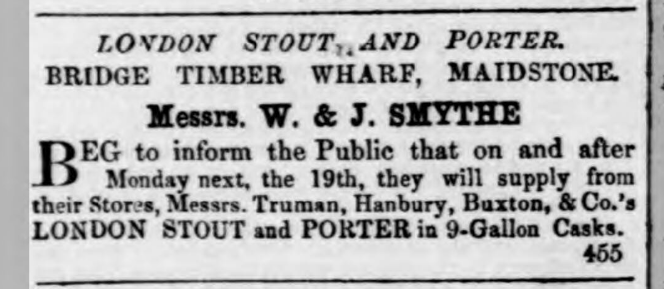
At the Maidstone Police Court on 11th January 1859, before the Mayor C. Arkcoll, William Hills, 31, captain of the barge “Albion”, Joseph Hills, 38, mate and Alfred Burr, second mate, was charged by Mr John Smythe with stealing several gallons of stout from the barge of which, with it’s cargo, they had charge of.  Mr Smythe stated that, from information he received, he communicated with the owner of the barge “Albion”, Mr Masters, who went with him to the barge, which was unloading at the Albion wharf. The vessel was freighted with stout, which had been obtained from Messrs. Truman and Hanbury’s wharf, London. Mr Smythe asked the captain, if he had got any beer on board in stone bottles or casks, when he replied “Not a drop.” The witness then went to the forecastle, when he saw Burr slip into the cabin, he followed him and immediately perceived a strong smell of porter, and he observed that the grate was swimming with the liquor, at least two or three quarts. Burr admitted pouring it out, because they might fancy it, was their beer. The barge was then searched and under a bed in the stern of the barge, two large stone bottles filled with beer were discovered. The police were called and in total about twelve gallons of beer were found and the prisoners were taken into custody. Captain Hills stated that he was innocent and denied that he knew there were any beer in bottles in the barge or that anything was placed under the bed. The others also denied the charge.

Mr Smythe said that large quantities of beer had been previously lost from the same barge, as much as 40 gallons out of two puncheons. The prisoners had formed the crew of the barge at that time , but the previous captain had since died. The prisoners were remanded to saturday 14th January.

At the next session, John Smythe was called, he stated he carried on the business of a porter merchant, in Maidstone, in partnership with his brother, and was supplied from the firm of Messrs. Truman and Hanbury, London. He contracted with Messrs. Masters and Son, for the delivery of stout and porter from the Black Eagle Wharf to the Albion Wharf, Maidstone. He supplied several customers with porter and stout, some of which were delivered by rail. He had received complaints from customers, that had been supplied with porter from the “Albion” barge. On the day in question, he had discovered liquor in the ashes of the grate and bottles concealed under the sleeping berth. On the following day, on a  further search of the barge, a piece of gutta percha tubing bent to the shape of a syphon was found. It was wet and and smelt of beer, and also a quantity of spiles and corks were found tied up in a handkerchief and a piece  of gutta percha tubing, a plug, hammer and three gimlets. These were concealed under the floor of the sleeping berth.

Mr Joseph Marriott Hancock, foreman to Messrs. Truman and Hanbury, said he examined certain tasks at the stores of Messrs. Smythe, and as far as the quantity of porter contained in the casks, there was not much astray with the exception of one of the barrels, which was about three quarts short. But the stout in some of the casks was greatly deteriorated, on examining the stoat that had been found in the bottles, he believed it to be genuine and the same in quality, as when sent from the brewery. On examination of the casks, he thought some of the corks had been removed, and in two of the barrels, he noticed the corks had not been put in the same way as their cooper put them in, and had been driven in by an inexperienced person. The stout sent to Messrs Smythe was all from the same brewing, and drawn from one vat.

Henry Herrington, in the employ of Messrs. Truman and Hanbury, said it was his duty to direct the casks and also to sound all casks prior to them, leaving the brewery, and on Saturday 8th, there was a quantity of casks, which left the brewery consigned to Messrs Smythe, Maidstone, which he believed to be full, when they left their stores, and the casks containing stout, he swore postively were quite full, as he had sounded them himself, and had good reason to be careful with the stout, as he had been cautioned by his master to be able to swear that the casks were full when delivered from their stores.

Mr Charles Barrett, deputy foreman to Messrs. Truman and Hanbury, deposed to shipping on 8th, at the Black Eagle Wharf, on board the “Albion,” 21 puncheons, 40 barrels and 30 kilderkins, all of which appeared to be in the usual good order, and gave them into the charge of the captain, William Hills.

William Masters, wharfinger, said the prisoners had been in his employ and that he was engaged by Messrs. Smythe to bring stout and porter from the Black Eagle Wharf, Wapping to Maidstone. William Hills had been in his employ for many years and J Hills, had also been employed for a long time, but not so long as the former and he had always allowed them money to get beer with.

Mr Goodwin, for the defence,  addressed the bench, and contended there was not sufficient evidence to convict the prisoners, there being only three quarts of stout missing, from such a large quantity.

The prisoners were committed to take their trial at the next assizes, and on application they were ordered to give bail in £100 each and two sureties of £50 each, with 48 hours notice.

At the Spring Assizes on 18th March 1859, William Hills, the captain of the barge, Joseph Hills and Burr were all found guilty. His Lordship in sentencing them, said they had been convicted on the clearest evidence of a most serious offence, that of having taken advantage of being entrusted with a cargo of stout and porter; to abstract from it a considerable quantity, and what was an aggravation of their offence, in order to make up the deficiency, they had spoiled in a great measure the remainder. It seemed to him that William Hills as the captain of the barge was the worst offender and he was sentenced to eight months’ hard labour and Joseph Hills and Alfred Burr to six months’ hard labour.

screenshot (205)

Home

The Public Execution of Dedea Redanies at Maidstone Gaol – 1st January 1857

The Public Execution of Dedea Redanies at Maidstone Gaol 1st January 1857.
The Maidstone Journal of 3rd January 1857 records the execution of Dedea Redanies at Maidstone gaol and an outline of his crime. On 1st January 1857, Dedea Redanies was executed in the front of Maidstone gaol for the murder of Caroline and Maria Back. Dedea, was born in Servia in 1830 and having enlisted in the Kossuth Cavalry, he was taken prisoner at the Battle of Szegadin. Accepting an offer from his Austrian captors, he joined the Reuss Regiment of cavalry and fought at the conflict of Novara. He was awarded a gold medal for an act of courage, after entering the enemy camp, disguised as a dram-seller and stealing their flag. After making clear of the camp, he was fired at and escaped by throwing himself from a high embrasure into the river. Whilst stationed In Milan, he befriended a Capushin Monk and was baptised into the catholic faith, previously declaring his faith as Mahommedan. He was able to recite the Lord’s prayer and other prayers in German and was familiar with the theory of Christ as a saviour and the crucifixion.
On hearing of the formation of the British Legion, he deserted and escaped through Sardinia into Switzerland, where he enlisted and was posted to Shornecliffe. With his knowledge of both the German and Italian languages, he was appointed as an interpreter to the hospital at Dover Castle. It was here that he met the Back family. According to his statement, he met Caroline and Maria Back, on the way home from the theatre, and Caroline soon became his lover. He was welcomed into the family and Caroline’s parents looked upon him, as a future husband to Caroline. Dedea, became jealous of a friendship between Caroline and an artillery man at Woolwich, and was further angered on seeing a letter from him addressing her as “Dear Caroline”. On hearing, Caroline was to visit Woolwich to see her sister Mary, he determined to kill Caroline. On Saturday 2nd August, he left the Back’s house to purchase a poniard (dagger). On his return he invented a story that his sister had arrived in Shornecliffe and was anxious to meet his future wife, the following morning. He proposed they walked there, the following morning at sunrise by the beach. Mrs Back at first objected but later consented on condition, that Caroline was accompanied by her sister Maria. The next morning, Mr Back saw the girls and Dedea. leave in high spirits, laughing and talking and they were seen on route in good humour by others, within a mile of the fatal spot, where their bodies were discovered. Dedea murdered Maria and then Caroline, and stated in a letter to Mrs Back that he had not intended in killing Maria, but she was in the way and that he killed Caroline as it had been “put into my mind at last that Caroline rather may she die at my hands than allow Caroline’s love being bestowed upon others” He rushed from the scene and was captured the next day, where upon he stabbed himself with the same dagger and was taken to a hospital in Canterbury. A German Roman Catholic priest was called to the hospital, as Dedea was expected to die, however he  recovered before his trial.
Prior to this execution, in the condemned cell, he was visited by the gaol chaplin Rev Watson King, the Rev. unable to communicate adequately with Dedea and on Dedea’s apparent lack of remorse, he requested a German copy of “The Sinner’s friend” from Mr Hall. Dedea requested to Rev Watson King, that he be accompanied to the scaffold by a German Roman Catholic priest, stating he wished “to be led to the place of execution by him who kills me, because I also led my poor dead girls to where I killed them.” Father Lawrence arrived at the gaol on Saturday 27th December. On meeting Dedea, Father Lawrence believed Dedea was not of a sane state of mind and conveyed this to the governor of the gaol Mr Bone. Mr Bone referring to the peculiar circumstances of the prisoner being a ‘foreigner’ and the difficulty of communication, he wrote to the Secretary of State Sir George Gray. A letter from Whitehall, dated 31st December 1856, however sealed his fate, with Sir George Gray expressing his regret, that he “can discover no sufficient grounds to justify him interfering with the due course of the law” and that “the prisoner was not insane when he committed the murders.”
On the eve of his execution, he finally regretted his crimes and spent several hours with Father Lawrence, receiving the sacrament. He was allowed to smoke his pipe and vowed to eat no more food that evening, he amused himself by drawing the scene of the crime. After a restless night, he stated he had been dreaming of being reunited with Caroline and Maria. He attended the usual prison church service at 9 o’clock and at 10 o’clock was accompanied by Father Lawrence, Rev Watson King, the governor and under Sheriff Mr Wildes to the scaffold. He was executed by the infamous executor Calcraft, in front of the prison, where a crowd of four to five thousand people had gathered. The mood of the crowd was described as “extreme quietude” and Superintendant Blundell reported no complaints of robbery from the crowd.
Sadly, Dedeas was not alone in meeting his fate that day. After the removal of his body from the scaffold, James Anderson and George Willmer, who were employed to dismantle the scaffold, were removing a cross-beam, when Anderson lost his balance and fell 15ft to his death. Mr Holliday was summoned and Mr Anderson was conveyed to the shop of chemist Mr Waterman, opposite the gaol. He was found to be deceased and the coroner T. Kipping declared an inquest was not required as his cause of death was so apparent. James Anderson had buried his wife, just three weeks before.

Home

Annoyances, rates and tin kettles!

Annoyances, rates and tin kettles!

At the Maidstone Petty Sessions on Friday 23rd November 1849, before the Mayor C. Scudamore and W. Hills, Mr Shreeves of Wheeler Street, appeared to complain of an annoyance to which he had been subjected to from a number of boys congregating near his house daily, including Sundays. The boys swearing, hallowing and using the most abusive language to all who passed. On the previous wednesday evening, twenty to thirty boys, some of whom were not from the neighbourhood, assembled and held what is called a “horn fair” and with their tin kettles, hallowing, and other disgraceful noises, assembled a crowd of fifty to sixty persons, who with great difficulty were dispersed by his intervention. The nuisances had occurred before and would probably do so again. On one occasion, he had his door broken and several windows. He therefore wished to know if this system of annoyance could be ended.

Mr Case said Mr Shreeves, if he should chose to, he could summon a party for breaking his window. To which Mr Shreeves, said he was quite aware of this, but to gain a conviction, he or another witness must be present at the very moment, the window was broken, which in most instances was impossible. He submitted to the court, a list of several of the principal leaders of the annoyances and Mr Crowther would corroborate his statement. Mr Crowther stated that the scenes exhibited in the locality, were of the most disgraceful nature and frequently, twelve to thirty boys, of whom some of the lads were just twelve to fourteen years of age, assembled near his shop, and abused and annoyed persons entering or leaving his shop. He also had windows broken and there appeared no end to the annoyance. He asked if a person could be summoned for annoyance to another.

Mr Case said it depended upon the nature of the annoyance and in some cases, the parties could obtain no redress. Mr Shreeves asked if the annoyances, that he had mentioned, such as for noise and ill language could not be proceeded against. That same day the court had prosecuted persons for short measures of just an ounce or two, whilst it appeared there was no law, against what he considered a much worse annoyance.

Mr Case stated if Mr Shreeves could satisfactorily prove a case against a person for breaking his  windows, damaging his property or swearing, and took  out a summons against the party, the magistrates would use every means in their power to give him redress. But they were unable to assist him against the other part of the annoyance to which he alluded, there being no law to prevent it and the magistrates were unable to make laws.

Mr Shreeves said they paid their rates and he thought they should receive something for their money and that they should be able to obtain redress. The Town Council made laws in some instances and he could not see why they could not in this case! The Mayor reminded Mr Shreeves that laws made by the Council were invalid, unless sanctioned by the Secretary of State; and asked him, whether he thought if Mr Fancett sent one of his men round to see the parents of the youths, who had committed the annoyances, that a salutary effect would follow. Mr Shreeves agreed that it might be of effect and after some further conversation, this step was ordered to be taken.

Home

The alleged ill treatment of an apprentice by his Master and Mistress.

An inquiry  at the Board Room of the Coxheath Union resumed on Wednesday 28th September 1864, regarding the case of William and Emma Simons, who were charged with ill using and neglecting to provide John Nicholls, aged 18, an orphan and their apprentice, with the common necessaries of life.  In attendance were C.G. Whittaker (the Chairman of the Board of Guardians) and John Whitehead, both justices of the peace for the Bearsted division, W.N. Ottaway and Mr William Pearson, acting as clerk for the justices were for the prosecution and Mr T. Goodwin for the defendants.

About two years, prior to the case, John Nicholls, who was formerly an inmate of the Union workhouse, having been left  an orphan, was apprenticed to William Simons, who lived at 45 Union Street, as a shoemaker. James Lambkin, who had married John Nicholls’ sister was a party on the indenture and it appeared since John’s mother’s death from consumption, James Lambkin had acted as a parent to John, and he and his wife had often visited the defendants’ house to check that John was properly attended to and gaining instruction in his business. For a long time, John had been in a weak condition and was gradually growing worse and his master Simons, deemed it necessary to remove him to the Union Infirmary, in consequence of an infectious disease raging in his own family, that had taken the lives of a girl aged 12 and a boy of six, suddenly in the same week. He was removed to the Union Workhouse, in a cab on Sunday 11th September and on arrival, Mr Baker, the master of the Union Workhouse, found John in a very weak and emaciated condition. On the following Monday, due to his failing condition, he was examined by Mr Stokoe, the medical officer to the case, after which coupled with statements made by John Nicholls, it was considered further investigation was required. The matter was referred to the Chairman of the Board of Guardians C.G. Whittaker, who in his capacity as a magistrate, attended the Union Workhouse with Mr Pearson, and a statement was taken from John Nicholls, in which he stated that during the time, he had been in his Master’s service, he had been subjected to acts of the grossest cruelty at the hands of his Master and Mistress, who had kept him without the common necessaries of life and had reduced him to a most pitiable condition. A warrant was issued for the apprehension of the defendants, but in consequence of fever being in their house, Superintendent Maloney refrained from taking them into custody. Mr Simons, however, promised to attend at the Union Workhouse, on the wednesday after, when in his presence, John Nicholls made a similar statement.

Mr Ottaway having stated the charge and the nature of the evidence he would  adduce for the prosecution, Mr Goodwin objected to the course pursued by the Bench, with respect to what has already taken place on the grounds, that the defendants were residents of the Borough of Maidstone, and therefore, in the jurisdiction of the borough magistrates alone, they could not proceed further than it related, to what actually transpired since the lad had become  a resident of their house. This point was argued for some time, with the magistrates deciding that they had jurisdiction in the matter and the inquiry proceeded. The magistrates then adjourned to a room used for the sick, where John Nicholls lay. The depositions taken at previous examinations were read over to him, which he affirmed were correct. The acts committed against him, were of the most barbarous character and John’s emaciated body was covered with abrasions and bruises, which favoured the belief that he had received the most unjustifiable ill treatment. Mr Goodwin proceeded to cross examine John and some of his answers in reply to questions, were contradictory, tending to show that his statements were partially untrue and the nature of the treatment, he received was possibly, not as serious as first indicated. At one time he stated that for nine weeks previous to his admittance to the workhouse, he was never allowed to leave his Master’s house, while at another time he admitted, he was well enough to attend the Foresters’ Fete in Vinter’s Park on 1st August and that on the Sunday, prior to his admission to the workhouse, he went for a walk with another apprentice for two hours. He also admitted to visiting his sister at Bearsted on Sundays, while at another time stated his Master would not allow him to go out on a week day or Sunday. In answer to enquires made by Miss Bentliff, superintendent of the King Street Sunday School, which he attended and to his own sister, he had stated that he received great kindness from his Master and Mistress, and was well fed and had a comfortable bed provided for him.

The Magistrates having adjourned to the Board room, the depositions of surgeons Messrs Paul Henry Stokoe and F. Fry were read. They were to the effect that when John was admitted to the workhouse, on viewing his ill conditioned sores and the extreme emaciation of his body, they were of the opinion that his present condition was owing to the want of proper food and gross neglect on the part of his master and mistress, which had accelerated disease and much reduced him. Mr Goodwin, for the defense, examined Mr Stokoe at great length, with a view to show that John’s present condition was the result of a severe attack of diarrhoea and dysentery, but Mr Mr Stokoe stated he was still of the same opinion, that when John was brought to the workhouse, his condition was attributed to the want of sufficient diet and proper attendance than to any other cause. It was probable from John’s statement and the conclusions he had arrived at in his own mind, that even if he had been suffering for several months, he would not have been reduced to his present exhausted condition by that alone. There was no doubt he was scrofulous (tuberculosis) though there were no signs as to the development of the disease in any form whatever. Mr Stokoe stated diarrhoea was generally not so injurious to the human frame as dysentery, and tended not to lead to emaciation, but his symptoms exhibited and the bruises and wounds on every part of his body would lead to a very different conclusion.

Mr Ottaway having produced the indentures and proved the apprenticeship of John, he produced further evidence for  the prosecution. The first witness Adaliza  Reynolds stated she lived at 49 Union Street and had lived there for 24 years. She knew the defendants and John Nicholls, their apprentice. He was always distinguishable from the other apprentices, by being called the lame boy. From where she lived, she had a good opportunity of seeing, what occurred in the shop. On Friday 2nd September, she stated she saw Mr Simons hit the boy, on the right side of the head with his hand, and fall to the ground. Mr Simons and John were in the shop together, and the back door was open, also the middle door which separated the shop from the back of the premises, so she was easily able to see, what was happening. She did not see John get up, but heard Mr Simons shouting “Get up! Get up!” She said to Mr Simons “You are aware I heard that? You will hear of that again.” Afterwards, she heard John, fall to the ground again. On another occasion, late one evening, she saw John standing in the corner of the passage, crying bitterly, it was raining, she felt much hurt that the boy should be treated in such a cruel manner as he was lame and had no one to care for him. She stated that Mrs Simons had come to her house and asked her not to appear, if required to do so and give evidence against her, but as the police were aware that she knew something about the ill treatment of John, she was compelled to attend. Another witness Adelaide Brown, living at 47 Union Street, stated one saturday, as she was passing the defendant’s house on her way to hop picking, she saw Mr Simons, several times, box John’s ear and saw him fall to the ground and Mary Callcott, living at 55 Union Street, said about three months ago, she saw Mr Simons strike John violently three or four times.

Superintendent Maloney stated he went to Mr Simons’ house and asked to see the stove, that John had been made to stand upon. Mr Simons took him to his workshop and admitted that he had stood John on the stove as a punishment. However stated that  “It was no more punishment to him than if I had placed him on a stool.” In Superintendent Maloney’s opinon, John could not have stood upon it, without it causing him considerable punishment, the stove was 18 inches high and only six inches wide on the top.

Mr Baker, the Master of the Union workhouse, Coxheath stated that John was an inmate of the Union and left about two years ago, to serve as an apprentice to Mr Simons. He was a hearty lad and apart from his lameness, he was healthy, when he left the workhouse. However on his admission on 17th September, he was in a most deplorable state, greatly emaciated. This closed the  evidence for the prosecution.

Mr Goodwin, then addressed the Bench for the defense, expressing the hope that the magistrates would not allow sympathy to take the place of justice, and that his clients might be allowed the opportunity of proving their innocence. They had seen the deplorable condition of the boy, but having heard the repeated contradications , regarding the accusations against the defendants, they would hardly think it possible , much less plausible, that they had been guilty of treatment, which would have them stamped them with shame and dishonour for the rest of their lives, and subjected them to a long term of imprisonment. Having pointed out the discrepancies in the evidence, he argued that John’s statement was a fabrication from beginning to end.

The witness Mercy Lambkin, the sister of John Nicholls was then called to give evidence . She stated she lived at Bearsted and her husband was a shoemaker and worked occasionally for Mr Simons, to whom her brother was bound as apprentice. Her brother has always had very bad health and since the death of her mother, she had looked after John, to the best of her ability, Her mother was once in the same feeble state that her brother was, and as  thin and emaciated when she died. Her brother frequently came to their house on Sundays and took dinner with them, when she always asked about his health and how he was treated by his Master and Mistress, his answers were always satisfactory.  As he had gradually grew thinner, she requested his master, not to allow him to come over on Sundays, as she considered the walk was too far for him. His master complained several times to her, that John was lazy and neglected his work. John had admitted to her, that he had not been a good boy, but promised to be better in the future. She had visited his master’s house, sometimes on business and at other times, just to see her brother. No complaints could be made against their manner of living, and when she had been present at meal times, there was good and wholesome food. He had the same as the other apprentices, who appeared to be treated the same as the members of their own family. When she last saw her brother at the house, he said he always had enough to eat and never complained of ill treatment. James Lambkin, husband of the previous witness corroborated his wife’s evidence and stated he had frequently remonstrated John, in consequence of his Master complaining of his habitual laziness. John had often offended his Master by spoiling his work, the result of carelessness and inattention. An application had been made the previous May to the Guardian of the Bearsted parish, regarding what should be done with John, in consequence of his feebleness, but nothing was done in the matter.

Another apprentice Robert Marriott, said John Nicholls had been treated as well as any Master could treat him. He always has the same to to eat  as himself and the other apprentice. Meat and vegetables every day and some kind of fruit pudding afterwards.  He was never ill treated by his master and the mistress never hit him on the head with his crutch. He suffered from diarrhoea, frequently and at such times was supplied with arrowroot and ground rice and fresh eggs every day. He always went out on Sunday and frequently during the week, when the work was done. On the Sunday, before he was admitted to the workhouse, they had walked along the Ashford Road, he had fallen twice, whilst out and hurt himself. He always looked very thin and was “dirty in his habits”. He could not have been ill used without him not seeing it, the mistress however, sometimes boxed his ears for his dirty habits. He always had a good appetite and ate heartily. He was however a bad tempered boy and neglected his work very much. in spite of his Master’s caution.

The witness Mr Pearson stated John went to chapel in the morning and sometimes in the evening. He did not go to chapel on the Sunday, before he was brought to the workhouse as Mrs Simons did not like to send him, as all their children in the house were suffering from fever. He was never required to work on a Sunday and had only once or twice, been placed on the stove as a punishment for his negligence, but was always allowed to get down as soon as he felt disposed to go on with his work. He asked him to get down to come down and get on with his work, but he refused. He did not recall seeing John in the washhouse on Sunday morning, when his nose was bleeding. He last went to Sunday school on 7th August. The bruises on his hips and knees were caused by his falling on the Sunday and he had suffered from diarrhoea, for about three weeks before his admittance to the workhouse. He had proper clothing and a good bed to rest upon and never complained that he had insufficient food.

Another apprentice Henry Watson corroborated the evidence of previous witnesses, in respect of the quantity and quality of food provided. He confirmed his statement regarding the stubborn habits of John, who was described as both lazy and dirty. He however admitted that the lad was several times stood on the stove, the longest time for three quarters of an hour, when the mistress had came up and told him to get down and go on with his work. He immediately got down and could have done so before, if it had not been for his temper and his disinclination to return to work.

Other witness Ann Coppen, Jane Payne (washer woman to Mrs Simons) and Ann Elphick all gave evidence, testifying to the kindness, shown to John, by Mr and Mrs Simons, and that the doctor had visited him regularly, whenever he was ill.

Mr C. Keen and Mr Randall (boot and shoemaker of Gabriels Hill) both spoke to the defendant’s character, the former having known him for four years and Mr Randall for 25 years. Mr Simons had worked for Mr Randall and during that period, he had entrusted to him, transactions of an important and confidential character. His conduct was exemplary and was such as was likely to have a wonderful influence upon his apprentices, in inducing them to temperate in their habits and to conduct themselves with propriety.

The room was then cleared, for the Bench to consider their decision, after an interval of about five minutes, the public was re-admitted. The Chairman stated “We have given this case our most serious consideration, but, looking at all the circumstances, the conflicting evidence and the contradictory statement of the boy, we are of opinion that there is not such a “prima facia” case made out against the defendants at present, to induce us to commit them for trial.”  A case of insufficient evidence for conviction!

The following week the Maidstone Journal reported John NIcholls’ death and that a post mortem had been carried out, in compliance with an order made by the Board of Guardians. Dr Monckton assisted by Mr H.P. Stokoe, the result of which found both his lungs and kidneys were diseased sufficient to account for his death. Other parts of his body showed symptoms of general decay of his whole system, and were of such a nature as to render it impossible, that he could have survived for any length of time. The examination was said to be “so far satisfactory to the public, and will show that the magistrates in their decision upon the matter pursued a proper course, discharging their duties faithfully and conscientiously alike to the public and to the guardians of the lad.”

A rather sad strange case and lots of conflicting evidence, it seems. One cannot however wonder that if the Guardians and his family had not shown him more love and care, when he was orphaned that his untimely death could have been avoided!  His apprenticeship to the Simons, was one less mouth to feed at the workhouse for the Guardians and for his sister and brother in law, an inconvenient problem resolved!

Home

An Irish Row at the railway station or the great Tonbridge Road Riot!

On Wednesday 24th September 1862, a good deal of consternation was caused in the neighbourhood of Maidstone railway station, by a large number of Irish hop pickers, who had assembled there to be conveyed back to London, by a special train, which was due to leave at 1 o’clock. The number estimated at between 900  to 1000, most of whom were, more or less inebriated. It seemed that a good many of the party had been located together throughout the season, and had indulged in frequent quarrels. On the day, the grievances were renewed and a general row arose. The combatants divided into parties, one side taking possession of the station yard and the road below, whilst the others were higher up the Tonbridge Road. Showers of stones were hurled in all directions by the women on either side, the men using their shillelaghs and bagging hooks in a most determined manner. The fight having continued for some minutes, those is possession of the upper portion of the road, succeeded in driving back their assailants, who turned and retreated as far as the bridge, many of them, in their flight receiving severe wounds. One young child of about twelve months, whilst in it’s mother’s arms, was struck on the head with  a large stone, which cut through the scalp and so severely injured the bone as to imperil the child’s life. The infant was conveyed to the West Kent Infirmary, where the wound was dressed, and later in the day, the child was taken to London, by it’s friends. One woman got her knuckles smashed, whilst the hands of another were cut with a bagging hook. Some were cut in the face and bruised about the body, several being knocked down and jumped on. Six of the injured were taken to the infirmary, but were able to leave after the injuries were attended to. The shopkeepers and other inhabitants were compelled to put up their shutters, or considerable damage would have been caused. The police’s efforts to repress the riot were powerless and it was not until the rage of the infuriated mob had spent itself that anything form of order could be restored, After the row was over, the Irish men were found in all manner of places, were concealment could be afforded. They were turned out of from a saw pit of Mr Baker’s premises, others had crawled between sacks of shoddy on one of the wharfs and one was buried beneath a heap of sawdust. Two men were removed from the train, one on the suspicion of having caused the injuries to the child, and the other for attempting to rescue him from the custody of the police, but as it was evident that they were the wrong persons, they were allowed to go on their way and all the Irish left the place, in the course of the afternoon.


The Fratricide at Maidstone

The Maidstone Journal of 4th August 1857, gave details of a case of Fratricide held at the Kent Summer Assizes on 3rd August. George Kebble Edwards aged 18, was charged with the wilful murder of his brother Thomas Edwards on the 19th March, at Maidstone. Sir Walter Riddell, Bart., and Mr Russell appeared for the prosecution and Mr Denham for the prisoner.

In opening the case Sir Walter Riddell said “it was his painful duty, on the part of the prosecution, in this case to lay before you the circumstances under which the prisoner at the bar is charged with the wilful murder of his own brother. It is impossible to say anything beyond that, as necessary to induce you to give your anxious consideration to this case. In the whole of the serious calendar of the assizes there has not been one case which more deserves the attention of a jury than the one I have now to lay before you. I shall state the circumstances as they occurred without evasion, and at sometime without reserve; and it will be for you to give your opinion and to say whether you are satisfied the prisoner committed, that which undoubtedly was committed – namely, the most savage and sanguinary murder of Thomas Edwards.”

Thomas Edwards was the eldest son of Daniel Edwards and his wife Mary Anne Edwards, who lived at 21 Bedford Row, on the Boxley Road, at the back of the gaol. The family consisted of the deceased Thomas, who was 24 years of age, the defendant George, 18 years of age and a younger brother named Samuel, aged about 9. They all lived together and the father, mother and Samuel slept in the front bedroom of the house, whilst the deceased and the defendant in the back bedroom. It was described as an ordinary four roomed house, with a cellar underneath. The front room opening with a door to the street and a small back kitchen, which opened into a yard. From the kitchen, there was a staircase up to the bedrooms and another staircase to the cellar. Thomas was described as a steady, well conducted, hard working young man, whilst his brother was described as an idle lad, who was often absent from the family home. On the monday, two days prior to the murder on 19th March, the family were all at home, and Daniel Edwards informed his son George, that he had obtained some work for him with his employer Mr Ames. George stated he had work elsewhere and a quarrel ensued between the brothers. They were both very angry but went up to bed as usual. The next day passed and the 19th, howevere without any renewal of the quarrel. In the evening at about eight o’clock, Daniel Edwards and young Samuel retired to bed, whilst Mary and Thomas remained downstairs. After a half hour had passed, Thomas also went to bed, whilst Mary waited downstairs for George to return home. She busied herself with preparations for the next day, going into the cellar, to chop firewood. Leaving the axe in the cellar, she went later back upstairs and George returned home at half past nine. No conversation was held between them and Mary went upstairs to bed, at about a quarter past ten. As she went to her bedroom, she observed  Thomas asleep in his bed. George remained downstairs, and was heard  to go to the bedroom after about ten minutes. Mrs Edwards returned downstairs to check if the doors was locked, as George was in the habit of leaving the house, late at night. Having checked the doors, she returned to the bedroom, and fell fast asleep at about half past ten. The family resided at No 21 Bedford Row and a person named King at No 20 and on the other side a person named Lee. In the front of the house was the street, and at the back there was a narrow causeway, which between Nos, 15 and 16, was communicated by an archway with the street. The causeway run under the back windows of all the houses. In the neighbouring back bedroom at No.20, a young girl Frances King slept.

Mary Edwards was awakened by hearing, what she thought was a moaning noise and found the deceased Thomas Edwards, lying on his bed, insensible and covered in blood. A candle lit the room and the window was open and George was missing from the room. At about the same time, Frances King, in the neighbouring bedroom, was alarmed by a noise, she then heard the window open and someone run past underneath. By this time, Daniel Edwards was calling for assistance at No 20, Francis King got up and with her mother went into the Edward’s cottage. Daniel Edwards was unsure, if the doors to the house were unlatched, when he gave the alarm to his neighbours. It was now about 20 minutes to one o’clock. A broken flower pot was found and a window pane broken in the window below, broken by someone climbing from the upper window.  Police Constable Leney came to the house, and he found the axe from the cellar under the bed, concealed by some clothes; covered with blood and human hair. Thomas lay with his head hewn to pieces, with two severe cuts, each of which divided both scalp and skull. His father was holding him and the bedding was saturated with blood. Thomas never regained consciousness and died about eight o’clock in the morning.  The whereabouts of George were unknown at this time. In the morning, it was found that George had gone to his uncle’s house at Brompton, near Chatham, some nine  miles away. His uncle also named Thomas Edwards, had not seen him for many years, and after he explained, who he was, he said he had been up all night, having taken a young woman home to Boxley. He remained there and went to bed. He got up at about 5 o’clock in the afternoon, stating that if he did not return home, he would return to his uncle’s house. He did not return and was apprehended in Rochester, the next morning.

On cross examination at the trial, Mary Anne Edwards stated her son had not worked for over a year and had been at home with herself. He used to worked for Mr Franklin and looked after his stock. He was a quiet, inoffensive lad, very silent who did not appear to keep any company, and shunned the company of acquaintances, preferring to stay home with his mother, whilst his brother and father were at work.  He did not drink and when visitors came to the house, he would sometimes hide in the cellar or his bedroom, remaining there for an hour or two, by himself. He was fond of pretending to use a razor, making lather, for an hour or two at a time, sometimes once or twice a day in his room or in front of the mirror, downstairs. He often did not respond to questioning and would frequently burst out into fits of laughter, apparently without any cause. When asked why he was laughing, he would not answer. On one occasion, when a man had come to paper the rooms, George shut himself in the bedroom, for the whole day, refusing to take any food. If he saw any one in the garden, he would not leave the house, hiding himself in the cellar or bedroom. He only went out at night and was frightened of the little girl Francis King, who lived next door. George liked flowers and was fond of “dumb” animals like the cat!

The surgeon Godfrey Sanders gave evidence, stating that he was called to see the deceased on the morning of the 19 March and found him in the back bedroom. He was struggling and quite insensible. He examined him and found a wound on the left side of the head five inches in length and passing completely through the skull and scalp, and dividing the membrane of the brain. There was a second cut on the back of the head, which has also cut through the skull and was about three inches in length. There was another wound upon the mouth and chin and another on the throat, which had perfectly severed the windpipe. He stated the blood was quite fresh and believed the wounds were inflicted, whilst he was lying in his bed, asleep. The wounds inflicted with considerable force, the blood would have flowed, rather than spurted as it was principally venous. He was in no doubt that the wounds inflicted by an axe, were the cause of death.

Thomas Smith, a police constable from the City of the Rochester, stated he met the prisoner in the High Street, Rochester, going towards Gravesend, at half past five in the morning. He had stopped him and asked his name. He had asked him, when he left Maidstone and about his brothers. He informed him, that he was taking him into custody for ill treating or murdering his brother, as he was unaware if Thomas had died at that time. George denied this and stated he could not take him into custody as he was not a constable, to which Thomas Smith had replied, that he was not a constable of Maidstone, but was a constable of Rochester. He took him to the station and sat with him for half an hour. After placing him in a cell, he asked George to remove his coat. he hesitated at first, stating “What for? you’ll find no spots of blood on me!” He searched George and found no traces of blood and told him, he was charged with chopping his brother with an axe, to which he replied “Not me!”

Mr Denham, for the defense. made an illusion to the prisoner’s state of mind. Evidence had been given to him, having an odd character and the prisoner himself had expressly desired that no defense of insanity should be entered, as he was simply innocent of the crime. The evidence against the prisoner was purely of a circumstantial nature and he reminded the jury of the words of the late Baron Alderson, that in cases of circumstantial evidence before a jury to find a prisoner guilty, they must be satisfied that his guilt is not only consistent with the facts, but inconsistent with any other rational conclusion than, that the prisoner is the guilty person. Mr Denham proceeded to contend that, although there was evidence to show the doors were fastened, it was equally clear the  windows were not fastened. That being so and with evidence of the irregular behaviour of the defendant, was it improbable that he gone out again, and that some midnight marauder had got in and attacked the first person, discovered in his midnight prowl. It was obvious that the prisoner had never been in bed, his mother was soundly asleep in a few minutes – what proof was there that he had not gone out? His father did not state if the door was fastened, when he went out to give the alarm. He went over the evidence of the defendant’s behaviour, and contended that there was nothing inconsistent with his innocence. His assertion that no spots on blood would be found upon him, were not remarkable, when it was remembered that Police Constable Smith (whose evidence the defense regarded as most disgraceful) had told him, that he had taken him into custody for murdering his brother. He reiterated the evidence of Mary Edwards, regarding her son’s eccentric manners and inoffensive conduct. Also the lack of blood found upon the George’s clothes, when it was evident that he had not had time to change, was worthy of consideration and the defense concluded that a merciful exercise of discretion, be given by the jury, so the poor people might not be deprived of both of their sons.

The Learned Judge, in summing up, discussed the two points raised by the counsel for the defense, namely that is was not established that he had committed the offence and secondly, that if he had, he was not in the right mind. Regarding the second, his mother had spoken of his eccentric habits, but the Judge stated that it was not possible, that a father, would not have been aware of his son’s insanity. The learned judge stated in all his experience, he had never heard a defense of that kind, put forward upon so small an amount of evidence. To the question of whether the prisoner was responsible for the murder of his brother, his Lordship stated given the experienced poverty of the household and its position, this was inconsistent with the idea of a desperado going in to rob and murder. No robbery had taken place, the supposed desperado who firstly would have needed to fetch the axe from the cellar and then gone upstairs to murder the deceased. If the facts adduced, failed to produce in their minds a conviction that he must be the murderer of his brother, they should find the prisoner not guilty, but if of a contrary opinion, it was their solemn duty to pronounce  him guilty.

The jury retired to consider their verdict and returned after ten minutes and delivered a verdict of Guilty, to which George replied “Thank God, I am innocent for all that!”

His Lordship. assuming the black cap, immediately passed sentence as follows:- George Kebble Edwards, you have been convicted of the wilful murder of your own brother. The facts proved against you were too strong, with all the chances – I should say fair play – the law gives to prisoners in our courts of justice, to allow the jury to find any other verdict, that they have done. Your unhappy mother, like a drowning person clutching at a straw, spoke of some of your former eccentricities of yours, to show that you were insane when you committed the dreadful act – it was but a straw. It is impossible to look at you in any other light than that of a person who has repeated the offence of the first murderer. There are but a few days intervening between you and the grave, and I entrust you to take advantage of the assistance you will have, and endeavour by a sincere repentance to make amends for your terrible offence. The sentence of the Court is that you be hanged until you are dead and buried with in the precincts of the Gaol. The prisoner was led from the dock, apparently slightly excited, but unmoved.

The grandfather of George Kebble Edwards was a native of Wales, and came to Coxheath as a Paymaster Sergeant in 1793, at the time the camp was located there. A prudent and careful man, he saved sufficient money to purchase a farm at Coxheath and soon afterwards was married. At his death, the farm passed to Daniel Edwards (George’s father), he however got into financial diffculties and was obliged to give up the farm and move to Maidstone, becoming a labourer. Daniel had several sons, all appeared to be respectable and anxious to do their duty in the state of the life, in which they were placed and generally respected, with the exception of George. Statements at the trial of George’s idle and irregular habits, were justified by facts, and it was more than certain that he had a close connection with a woman of bad character in the town, and through her, with a number of others of the like abandoned lives. From the time of his conviction, he was regulary visited by the Reverend Joseph Knott. a minister of the dissenting congregation, who worshipped at a place known as the “Tabernacle” in Romney Place. Until the day before his execution, George had constantly affirmed his innocence and on several occasions, when spoken to on the subject, had exclaimed “it served him right” in reference to his brother. Mr Knott had continually pressed upon him the importance of confession, and on the Wednesday before his execution, George made a statement, which he afterwards wrote and handed to the Governor of the Gaol, Mr Hillyard. He wrote “Sir – Its being your desire for me to write the particulars of my case, concerning the death of my brother, I am determined to speak the truth and nothing else but the truth. You know all along I have persisted in my innocence – that has not only been a matter of pleading. Pleading not guilty is not telling a falsehood. The reason I persisted in my innocency so long, I shall not mention it – not because I expected to get a reprieve now. The night of affair happened, I went out after my mother went to bed. I walked down town and met with a young woman that I knew. I went with her round to Boxley and back to Maidstone again. I stopped with her till about twelve o’clock at night- then went home and went upstairs to bed. I pulled off my jacket and was going to undress to get in bed, when the deceased said he should lock me out another night if I came in so late, and was a good mind to do it that night. I being under the influence of liquor, high words began to rise between us. There was a lot of walking sticks in the corner of the room. He took one of them up, and struck me with it on the head. It happened to hit the bedpost before it hit my head – that made it come on my head all the lighter. If it had happened to hit me first on the head, it would have killed me on the spot. If I had not bobbed on one side when he struck that blow it would have been fatal. I bobbing on one side, that made him hit the bedpost before it hit my head. I being so excited at the time, I ran downstairs, and got the axe, and went up stairs again; and just as I got top of the stairs he struck me with the stick. It hit me on the arm, where I carried the marks several days. As he struck me with the stick I ran in at him with the axe, and then we has a regular duel. He fell backwards on the bed – that is when I struck the blows. After that I put the axe under the bed, and opened the window and throwed the jacket out, that knocked the flowerpots out of the window and some of the flower pots hit on the fence below and bounced across and hit the window and broke one of the panes. So I can assure you it was done in great excitement and irritation. Then I left the house and went down town and stopped in a brothel till about three o’clock in the morning. Then I started off and went to Chatham. If he had not spoken to me that night in question, I being under the influence of liquor that my temper rose all the quicker. I should not have committed that atrocious, horrible and diabolical deed. All what I have stated here is perfectly true. Though I struck too hard at the deceased, I never had no intention of doing what I did. However it is done now, and I am very sorry for what I have done. I hope he is now in Paradise – that is all the harm I wish him. That is all I can say about it. After the duel was over I went down stairs and out of the front door.” No truth was given to the confession, a quantity of walking sticks were found in a corner of the bedroom, but no duel had taken place. On the wednesday afternoon and evening, George also wrote two other letters, one addressed to his parents, expressing regret for his crime and contained a hymn, he had copied from a hymn book. The other was intended for the abandoned woman, who in confession to Mr Knott, he admitted to having spent the remainder of that night after the murder. It was enclosed with a letter of thanks to Mr Knott, he asked for the letter to be sent to Mr Reynolds’ press office, so the woman could see it. The letter commenced with terms of endearment and then launched into details of loose women, some named and others alluded to, with the “occasional expressions of the vilest sort.” he finished the letter stating “A few more hours that I shall be launched into eternity, So farewell my beloved pet, from your sincerely affectionate and loving George Edwards.”

On the morning of the execution, 20 August 1857, he was taken to the gaol chapel for the ordinary daily service and he handed the letters to Mr Knott. As the hour of the execution approached, he became less confident and could not maintain his outward appearance of calmness, without great effort. He was hanged alongside Stephen Fox (who had murdered Mary Ann Hadley) in front of the gaol, before a large, but orderly crowd, by the infamous hangman William Calcraft.

The last execution of a fratricide in Maidstone had taken place on 21st August 1655, Master Freeman Sonds, second son of Sir George Sonds, of Lees Court, was executed at Penenden Heath for the murder of his older brother. He was buried in Bearsted Church.

©grimcrimesandunfortunateevents

Home
Fatal accident at the gasometer works.

The Maidstone Journal of 26th July 1900, gives details of the ceremony at St Peter’s Street, Maidstone, for the laying of the foundation stone for the new gasometer, which was being built on land adjoining the Maidstone Gas Company’s works. The ceremony performed by George Marsham. Several directors of the company were present; Mr Smythe – Manager, Mr Hickmott – Collector and others. At the ceremony, George Marsham was presented with a silver trowel by the contractor and afterwards, they enjoyed  luncheon at the company’s board room at the gas works.

During the construction of the gasometer, a young man named Harry  Kerton, was fatally injured on 12th March 1901 , when he fell through an aperture in the roof on to a cement floor, 35 feet below. He sustained numerous injuries, breaking his arms, shoulder and leg, he sadly died on the following Sunday. Harry fell into some water, between the brickwall and iron meter. Another man named Barmer, slid down  a scaffold pole and rescued him from drowning.  Harry Kerton was a native of Armley, near Leeds.

At the inquest held on 19th March at the hospital by the Borough Coroner Mr R. T. Tatham, ex Superintendent Dalton was chosen as foreman of the Jury. Mr Smythe and Mr Robert Hoar represented the Maidstone Gas Company. The following evidence was given by various witnesses:-

John Richard Kerton identified the deceased as his son, who was 19 years of age and stated he was employed by Messrs Clayton and Co. as a holder-up of rivets. Messrs Clayton of Leeds, Yorkshire were the construction company of the gasometer.  Albert Britten deposed that he was working at the gasometer and the accident occurred about 3 o’clock in the afternoon, and he witnessed the deceased falling on to the concrete flooring on which the gasometer was to be placed. He at once informed Mr Ashmell, of the accident and went to the gas house to call for a  doctor.  Mr Ashmell, the foreman in charge of the works, stated that some may regard the work, Kerton was doing was dangerous, but very few accidents occurred. The deceased was a journeyman and experienced at his work. He had been removing some plates off the top of the gasometer, but left it, to attend to a guide rope and then returned to where he had moved the plates, and fell through the hole. Plates were removed to allow light into the structure, as men were working inside. He had left the deceased only half a minute, and at first could not believe, it was he who had fallen. He stated he must have been on the wrong side of the hole, the men were instructed to go on the lower side. The construction was not slippery and the men were continually walking on it. The deceased had fallen on to the concrete floor and then rolled into about a foot of water.

Mr Dalton, the Jury foreman, asked Mr Ashmell, why no guard was placed round the hole, when a plate was removed to prevent anyone falling. In reply, he stated it was not customary, to do so. Mr Dalton stated he thought the work looked dangerous and if the plates were constantly shifted. Mr Ashmell replied, that he had many years of experience and had never heard of such a case before and that the deceased had removed the plate, himself, only a few minutes before.

Dr Krumbholz, the house surgeon at the hospital, stated that on admittance, Harry Kerton was suffering from severe shock. He never regained consciousness and was incomprehensible. He was bruised above the right eye and death was caused by brain injury. His right femur and right forearm were fractured and there were additional injuries. The Coroner, in summing up, stated Mr Dalton’s questions were proper but the “poor fellow had himself moved the plate, and must therefore have known of the danger.” After careful consideration for both parties, the employer and employees, he thought the Jury would agree that this was a “pure and simple” accident. The deceased was engaged in his regular calling and had opened the hole, himself. The Jury returned a verdict of “Accidental death.”

Mrs Kerton, the mother of the deceased, expressed the opinion that the top of the holders were very slippery and she thought planks should be put round a hole, when a plate was removed. It could be easily done, and if a man then slipped, he would not fall down the hole. Her son never wore nailed boots. Mr Ashmell said he would do everything, he could, that the Jury thought fit, but as there were men working inside the gasometer, engaged in rivetting the roof, if all the holes were closed, it would shut out the light, and the work would be more dangerous.

Home

Murder at Tovil

The West Kent Guardian of 24th September 1836 reported an inquest  held on 19th September 1836 at the Royal Paper Mill, Tovil, before the coroner F.F. Dally, on the body of Ann Covus, who had died on the evening of Saturday 17th September, by falling down the stairs of her house. Evidence was conflicting and it was queried whether she was pushed by her husband down the stairs, as her husband was known to have previously ill treated her or possibly fallen, due to being slightly intoxicated. Anne Covus, was fifty three years of age, and had been married some seven years to William Covus, prior to their marriage, she was a widow. They were married at Boxley Church on 2nd November 1829. The inquest was adjoined to 27th September 1836.
The following edition of the West Kent Guardian of Saturday 1 October 1836, reported that there had been considerable excitement amongst the residents of Tovil, after it was reported that Ann Covus had been murdered by her husband. Cries of murder had been heard from the house, and a crowd of inhabitants had pushed open the house door to find Ann Covus’ lifeless body at the foot of the stairs. William Covus was immediately charged with the murder of his wife. William Covus stated that on the night of  the alleged murder, he and his wife had, had words about her being out late, they had prepared to go to bed when, he heard a shuffling, which sounded like a fall and cry. He went downstairs and found his wife lying at the bottom of the steps, with her head upwards. There was still room for him to pass by her, without interfering with her! Several of the neighbours came in to the house and he did not interfere. The neighbours stated he had pushed her, down the stairs, which he denied. The neighbours carried her upstairs and were uncertain, if she was sober or had suffered a fit. She was subject to fits and had fallen during a fit on the friday before. She had remarked at the time, that if she had another fit, it would be her last. Two years ago, she had been confined for six months in the lunatic asylum. William Covus, the son of William, reported that he had been sent for, on the Saturday afternoon, as Ann had been taken ill on her way home, she was scarcely able to walk, and he had held her up. He had taken supper with her, and she was tipsy at supper. He said his father and the deceased, often argued but he had never seen his father hit her. Two other witnesses Esther Quinnell and Jane Baker, both spoke against William Covus. William Covus, the son, stated he had challenged his father, after he had broke the door open, and accused him of killing Ann, which he had denied. His father had not replied but struck him. On witnessing a female neighbour attending to Ann Covus, his father had stated “Let the _ die, and her son along with her.” Sophia Tugwell, a married woman, who was close to the Covus’ back premises, on the Saturday night, stated she had heard them, quarrelling, he had threatened her and stated that “if she came upstairs he would break her neck down again. She saw Ann go upstairs, followed by William, and heard Ann exclaim “Oh,Oh Covus do not” She was gasping for breath and she screamed out “murder” and fell with a great force. She had shouted to William Covus to open the door, and William said “bring me a light, let me see where she is – she is dead – I shall die tomorrow” The door was forced open by W. Susans. Sophia Tugwell stated she had known the deceased twenty years and had never seen her tipsy, her daughter corroborated her mother’s evidence. After the second day of the inquest, the jury returned a verdict of “Wilful murder against William Covus” The coroner issued a warrant for the committal of William Covus to the Maidstone Gaol, he was apprehended the next day after a “stout” resistance and lodged in the gaol.

At the trail on 13th March 1837, William Covus was found not guilty, the cause of death for Ann was given as simple apoplexy. Mr Bodkin, stated he had examined the deceased Ann Covus, and found a fracture in the second vertebrae of the neck and a dislocation of the first. He stated she may have had apoplexy and fallen down the stairs afterwards, and it was difficult to find the exact cause of death. Esther Quinnell, stated she lived next door to the neighbour and had heard William and Anne Covus, arguing about money. She had heard William, use some very bad language and run upstairs. She went to the Covus’ door and asked William, what he was doing. He stated it was nothing to do with her and she then alarmed the neighbours. Sophia Tugwell and her husband Phillip stated they lived next door, but one to the Covus’ and heard them arguing, and Sophia stated she heard William threatening to kill Ann, on account of her spending 10 shillings. She had heard Ann, callout “murder” and heard a gurgling noise and tumbling down the stairs. Mahala Tugwell corroborated her mother’s statement. Another witness Mary McCoy stated that Ann was at her house about 9 o’clock and had something to drink, and she was very much given to drink. Another witness Jane Baker stated she had worked with Ann at the paper mill and had known her for many years and that on friday 16th September, she had fainted and fallen down, bruising her face and she was not given to drink! Ruth Holloway and Eliza Baker, shop keepers at Tovil, stated Ann had visited their shops on Saturday night and she was not tipsy. Several other witness spoke for William Covus, who described him as being of a most exemplary character for humanity and Mr Clarkson made a good defence case for him, and he was acquitted.

I think this case is interesting, as there seems to be much contradictory evidence, I personally think William Covus was guilty, how could his wife Ann have shouted out “murder” if she was having a fit or stroke? The lack of concern and indifference by William, to his wife laying at the bottom of the stairs, also seems alarming.

From the late 14th to the late 19th century, apoplexy referred to any sudden death that began with a sudden loss of consciousness, especially one in which the victim died within a matter of seconds after losing consciousness. The word apoplexy was sometimes used to refer to the symptom of sudden loss of consciousness immediately preceding death. Ruptured aortic aneurysms, and even heart attacks and strokes were referred to as apoplexy in the past, because before the advent of medical science, there was limited ability to differentiate between abnormal conditions and diseased states.

Interestingly both the Quinnell and Tugwell families were still living in Tovil in 1841, and are recorded on 1841 census. Ruth Holloway was a baker in Church Street, Tovil. The census also reveals that the majority of residents were employed at the paper factory.

Home


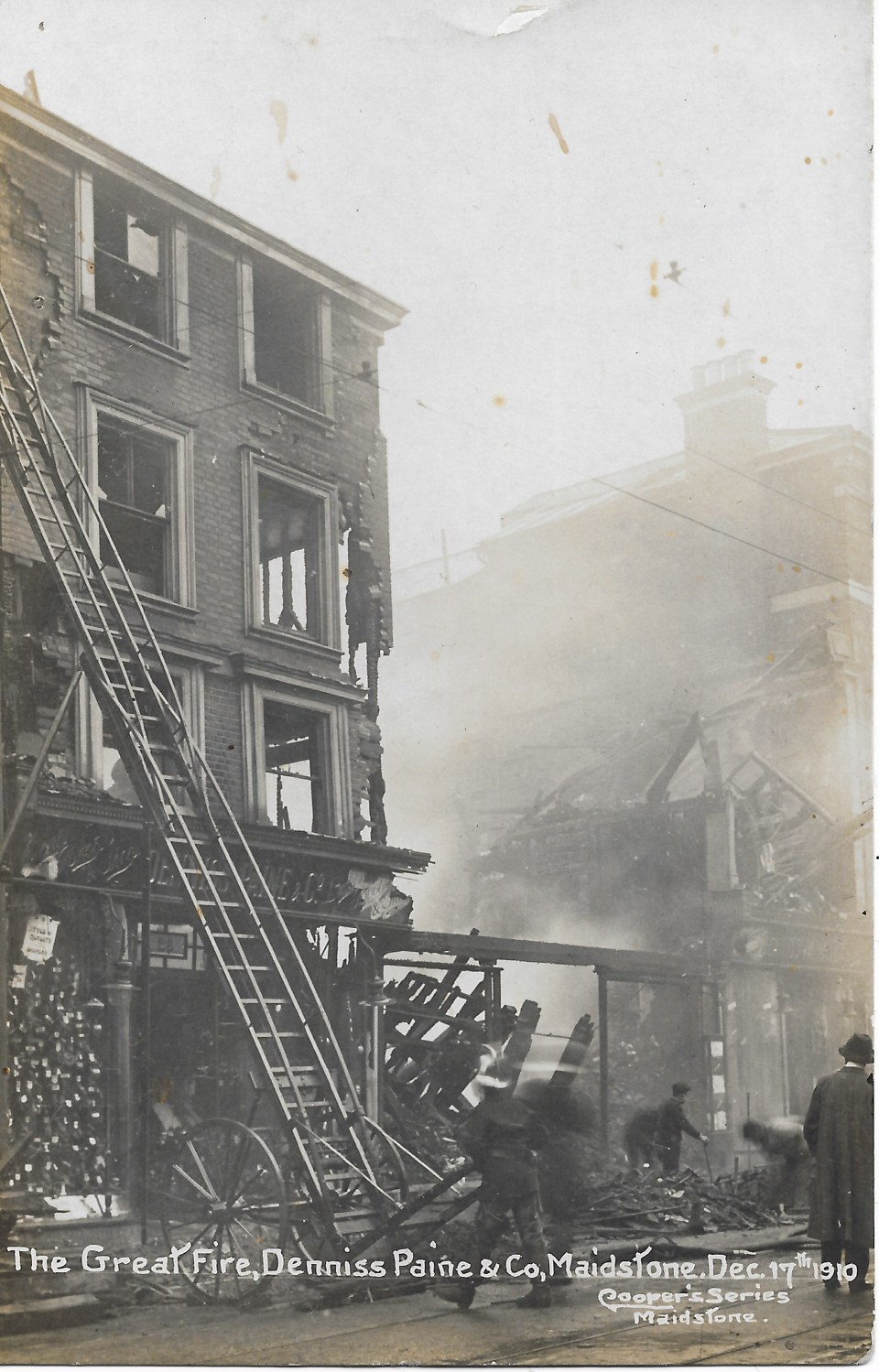
Fatal Fire at the Denniss Paine shop, Maidstone

The Denniss Paine shop fire – Saturday 17th December 1910
The fire that occurred at the Denniss Paine shop in the High Street was one of the worst fires in Maidstone’s history and resulted in the death of one of it’s youngest employees Oliver Goldsmith Hammond. Oliver who lived with his parents John and Thirza Hammond at 238 Upper Fant Road, had only been employed at the shop for just over a week. Oliver was one of ten children. The shop was one of the oldest established businesses in the town and comprised of several adjoining shops in the High Street, it had several departments; including furnishings, millinery, drapery, footwear and outfitters. The fire started in the ‘Fairyland’ display of the toy section, which was at the rear of the drapery department. Dolls and various figures representing a christmas scene were arranged amongst cotton wool and ‘snowflakes’ with lights suspended above the display. A flame was seen to shoot from the ceiling above the display. A dozen customers in the showroom, were startled by a cry of fire, and after a futile attempt to extinguish the flames, staff and customers made their way to the various exits. The fire spread quickly throughout the shop and four employees became trapped in the building: Mr Baker, Mr Morris, Fred Arnold (described as a lad from Tovil) and Oliver Goldsmith Hammond. Fred escaped by jumping from a window in the Millinery department and was caught in a canvas window blind, held by firemen in the street below. Mr Baker and Mr Morris also managed to escape via a lavatory window over the showroom roof. Thousands of onlookers gathered in the street, and precautions were taken by the police, assisted by the boy scouts, roping off an area from the canon to the Star Hotel. The shop roof collapsed and sparks and embers were carried by the wind over Middle row and Bank Street. Hose pipes were ran from all directions and the Corporation fire engine was employed in pumping water from the river. Eight hydrants were brought into service and a mile of piping was used from the fire station alone. The Chatham fire brigade arrived at 7 pm, but were called to a chimney fire at Waterloo Road.
At the Coroner’s inquest, Oliver’s body was identified by his father John Hammond, who stated his son was just fourteen years of age and was employed by Denniss Paine as a shop boy. Mr Paine, a partner in the business was asked by the Coroner, when he had last seen Oliver, and he stated that it was in the showroom and he had instructed him to sweep up part of the shop. Lieut Wainscott of the fire brigade, stated that Oliver had been found in the shop at no. 24 and the second floor had fallen through onto the first floor. The second floor was only accessible by a broad ladder. Mr Paine was asked by the Coroner, if Oliver had any belongings on the second floor; which would have given him reason to access the floor and if he lived on the shop premises. Mr Paine was further questioned about the lighting in the ‘Fairyland’ display. He stated the wiring was installed by the Borough Electricity works and had been in position from 7th December. Howard Tindall,an electrician from the Maidstone Corporation was called to speak about the electric installations and if any safety advice was given regarding the use of combustible materials in the displays. He had advised that two pails of sand, be kept on hand, in case of fire. Howard Tindall said the lights were eight candle power carbon-filament lamps, attached to insulated wires, suspended from the ceiling. He stated the lamps were not considered dangerous, but could become overheated. He stated the wiring was properly installed but there was the possibility that the lamp globes could explode. An employee Gertrude Brooker, stated she had seen a blue light on the left hand side of the ‘Fairyland’ display at 5.20 pm and had ran down the showroom, to switch off the display lights. She heard customers shouting “Fire” and had informed Mr Paine. Mr Pettitt, a buyer from the Toy department, stated he had tried to extinguish the fire, by patting it out with a stick, he stated he had not used the sand as the fire was too advanced and could not be used to extinguish the flames on the ceiling. Mr Hoadley, an electrical engineer from the Corporation, was questioned as an expert and said that if a lamp burst it was possible, for a piece of the feeding in metal above the filaments to be sufficiently hot to fire any very light substance, such as a muslin or cotton wool upon which it fell, but the filament itself would be dead immediately it came in contact with the air. Fred Arnold stated he had last seen Oliver Goldsmith Hammond, when he was attempting to escape the fire, he was following Mr Baker and Mr Morris to the lavatory window but he and Oliver was cut off by the flames and smoke, leaving only two other means of escape, through the warehouse, the route taken by Fred and via the ladder to the second floor above No. 24. Newton Tyman, a packer said he had seen Oliver, sweeping the shop as he was leaving the shop into the High Street, just before the fire started. He had seen the window open at the top of 24 and Oliver at the window. Several witnesses saw Oliver at the window and the firemen attempted to reach the window, but their ladder was too short to reach. The Coroner questioned why longer ladders were not taken to the fire and Capt Gates of the fire brigade explained that as the call came, the hose cart and short ladder were immediately sent. When he arrived at the scene, he asked Mr Paine if he had a roll call of his employees and Mr Paine had informed him, that everyone was accounted for. The long ladders could not be carried on the hose cart and as the fire was close to the station, one man with the cart, 500ft of hose and the short ladder were sent to the scene. Capt Gates had been informed by Mrs Hammond on Sunday at 1.30 pm, that Oliver had not returned home, the building was then searched and his body was found under fallen timber. The damage to the shop was estimated at £70,000.

At the annual Volunteer Fire Brigade dinner in 1895, Captain Gates, of the Kent Fire Office Brigade had warned that the “Denniss Paine’s premises would burn like a matchbox if alight”. The 1910 fire was not the first fire to occur at the premises, there had been two earlier fires; in September 1897 a small fire occurred but was quickly extinguished and again in August 1908, when a youth almost caused a serious fire, by first trying to extinguish a burning gas jet with an oily apron and then when the apron caught fire, by dropping it in some turpentine spilt on the floor. This ignited the remaining stock of turpentine and the fire brigade had taken an hour to put out the fire, causing considerable damage. Unfortunately, for Oliver Goldsmith Hammond; the warnings seem to have gone unheeded. The shop reopened in a third of the premises, the following tuesday. Advertisements advised, new stock would be arriving daily and damaged goods were greatly reduced.

Scan_20200905

Home

Fatal accident at Aylesford

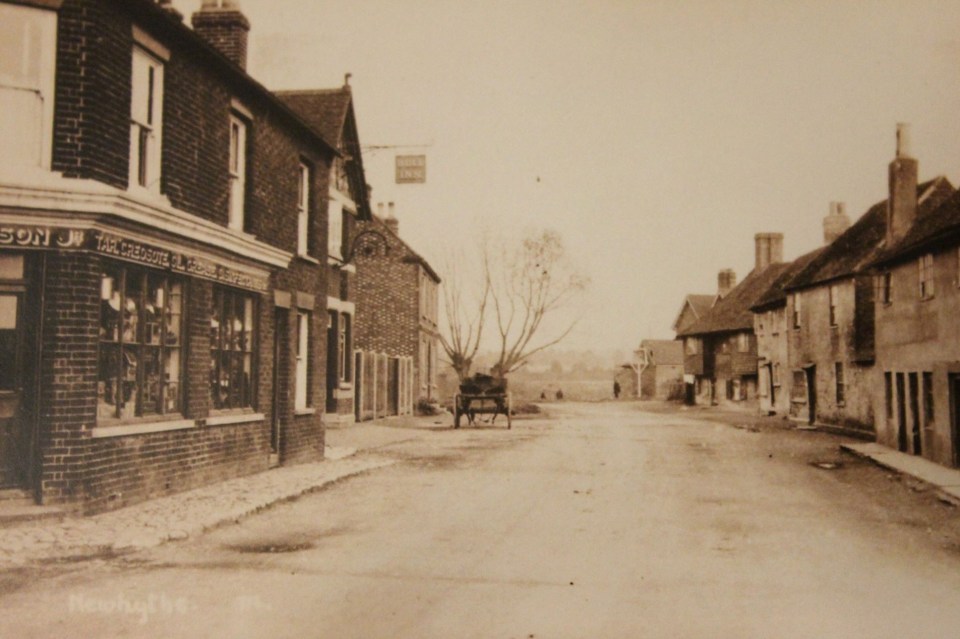
On the morning of Tuesday 9th July 1895, a sad accident resulted in the instantaneous death of a widow named Sophia Gower,  aged 59 of New Hithe.  Now known as New Hythe, the Maidstone Journal records the place name as New Hithe. The accident took place on a footway, across the North Kent Railway, close to the New Hithe Crossing. An inquest was held by the Coroner T. Buss, on the following wednesday evening, at the Ferry House Inn. Mr W. J. Johnson was chosen as foreman of the jury and having viewed the body, which was frightfully disfigured, the following evidence was given, regarding the accident:-

Ralph Gower, a clerk at the West Kent Cement Works, identified the body as that of his mother, with whom he lived. He stated she was very deaf, and as they lived close to the North Kent Railway, his mother was in the habit of crossing the rails. He had last seen her alive on tuesday morning, when she said she was going to Larkfield. On the journey home, he stated the deceased would have needed to cross the line, but she had always been very careful in doing so, before.

Henry Upton, another resident of New Hithe, stated as the 10:30 train from Maidstone was coming along, he was standing at the door of his son’s house, from where he could view the train coming. As it approached, Sophia Gower who was coming from Larkfield, having got over the stile, was crossing the line. She was walking very slowly and was holding her umbrella up, to shade the sun. Having noticed, she apparently had not seen the train coming, he shouted to her, whilst the train driver, turned off the steam and opened his whistle. Sophia, however took no heed and just as she got her left leg up on to the metals, the train caught her and knocked her down. Afterwards the train was pulled up, but Sophia was already dead.

George Mobbs, the gateman at the New Hithe crossing, also gave evidence. He stated he saw Sophia Gower on the line and the approaching train, he had shouted and waved his arms to warn her, but she did not see him. The force of the blow received to Sophia, knocked her off the up line, on to the down line. The foreman of the jury asked the witness, if there was enough time to have run to the deceased, when he saw Sophia had not noticed him, he was just 60 yards away from the deceased and the train 200 yards away. He also asked why there were no notice boards, warning people of passing trains.

William Robinson, the train driver stated when he saw Sophia, he blew the train whistle and partly pulled the train. When she seemed to have stopped, he released the brakes, however she started walking again and he did not have time to pull the engine up again, before reaching her. Subsequently he had found Sophia’s umbrella on the front of the engine.

The Coroner, in summing up, said he thought no blame could be attached to anybody. The jury returned a verdict of “Accidentally killed” and the jury asked the coroner to write to the South Eastern Railway Company, requesting the stiles at the footway should be replaced with clap gates, which could be locked from the New Hithe box, when trains were signalled. The inquest concluded, with the Coroner and the Jury expressing their sympathy to the relatives of the deceased, in their sad bereavement.

New-Hythe (2)


Home