Author Archives: grimhistoricmaidstone

Dr. Newton’s visit to Maidstone.

DR. NEWTON’S HEALING MEDIUMSHIP.

Extracted in part from issues of the “The Spiritualist” 1870.

Since the issue of the last number of this journal, Dr. Newton has paid Sunday visits to Andover, Maidstone, Birmingham, and Kingston-on-Thames. He will remain in England till the middle of September, when he leaves for Rome and Jerusalem, in both of which places he intends to heal the sick poor, without charge, as usual. We have received the following particulars about Dr. Newton’s visit to Maidstone, where he was very successful, partly in consequence of the excellent arrangements, the names and addresses of the invalids being all taken, and the observers being admitted by tickets, and placed where they could look on but not interrupt :

To the Editor of the Spiritualist.

SIR, —Having been present at the reception of Dr. Newton on his arrival in London, and having then subsequently witnessed several striking cures, and received benefit also myself, I felt desirous to secure his powerful influence for several of my own suffering friends, as well as for the afflicted of this town and neighbourhood in general. I invited him to spend one of his Sundays at my house, to which he kindly assented, fixing the 24th July. He arrived the previous evening, and commenced his healing efforts before ten on Sunday, working hard until nearly one o’clock, during which space of time he treated fully 180 invalids, being an average of one to a minute, besides finding time occasionally to address those present in several short and stirring speeches.

I had prepared and covered a large yard and coach house, capable of accommodating more than 500 persons, and I suppose 300 may have been present. Great harmony prevailed, and all appeared deeply interested in the novel proceedings, and, at the close, a hearty vote of thanks was accorded to me. Dr. Newton expressed himself highly satisfied, and stated that he felt the conditions were more than usually favourable for the successful exercise of his great gift.

I find the Doctor’s remarks were received very differently, according to the varying state of mind of his hearers, some were sorely offended at his profession of personal purity, or freedom from sin, and which he stated was needful for the effectual and proper exercise of the gift of healing. Others took umbrage at his denial of the exceptional Divinity of Christ, and his attempt to account for his so-called miracles in a way consistent with the laws of nature as exemplified in the science of psychology. Still, I believe not a few felt a true sympathy for the Doctor’s views, and the evident honesty and enthusiastic earnestness which animated him in all he said and did, could no fail to produce a good effect, and to insure respectful attention even from those who widely differed from him. I think it is best that the Doctor’s observations should follow, and not precede or accompany the healing, for I fancied I could perceive a decided diminution of power after he had finished an address, probably arising from a feeling of opposition in some portion of the audience, or possibly from a partial exhaustion through the effort of speaking. As to the cures effected on this occasion, I am not yet prepared to report fully, as I purposely allowed some time to elapse before I began to make inquiry, except so far as to question each patient immediately after leaving the Doctor’s hands. I give you the following cases, however, which have just been investigated, and may be fully relied upon, and I hope to be ready for your next issue with a more complete statement.

THOMAS GRANT. Shirley House, Maidstone, 10th August, 1870.

Thomas Grant was the maker of Kent’s best morella cherry brandy and he lived at Shirley House which was situated next to the factory in Maidstone.

(The “Spiritualist” explains that in the June number of the SPIRITUALIST, were 105 cases of cure by Dr. Newton with full names and addresses; in the July number 11 of these cases were shown not to be reliable, reducing the number to 94. Therefore Mr. Grant’s list begins with number 95. Of course, in a country town like Maidstone, where everybody knows everybody else, the reality of the relief given must be indisputable!)

95.* Mark Antony Twort, photographer, age 41. Great sufferer from indigestion for 6 years, causing a dull heavy pain about the heart. Dr. Newton called it heart disease, and promised to cure him, but for seven days after he saw the Doctor he was much worse, when, as he states, something seemed to drop or break away from the neighbourhood of the heart, and since that time he has been better than for years past. He thinks something has been forming internally for some years, and now seems to be gone entirely. He appears very grateful and talks of writing a letter of thanks to Dr. Newton. 96. Mrs. Martin, Wharf-lane, is grateful for benefit received. Rheumatic pains in hips disturbing her rest. Has now lost all pain, except a slight pain in the knee; sleeps well, and is wonderfully better.

97. Samuel Twiner Smither, 80, Union-street, age 22, deaf eight or nine years. Saw his mother, who states he can hear much better, as a proof she mentioned that in the night he was alarmed at a slight noise in his room made by a cat playing with a piece of newspaper.

98. John Dyer, Mill-lane, age 61. Great sufferer, and lame from rheumatics. Very much better. Walks without a stick, and can put his hand up to his head, which he has not been able to do for a long time.

99. William Ayres, Hart-street, age 43. Leg was broken about eight years ago, and until he saw Dr. Newton he had not been able to bend it; he can do so now, and put his foot to the ground.

100. Thos. Simmonds, builder, age 59. Has been seriously disabled and pained four and a half years, by what his doctors described as a loose piece of cartilage under the cap of the knee, causing the joint to be frequently upset by anything striking the inner side of the foot, notwithstanding that he always wore a laced elastic bandage, which he dare not leave off for an instant. He has consulted several doctors who have tried to move the joint in various ways, and a serious operation was proposed, but he was advised not to consent to it. Dr. Newton pressed the sides of the knee cap, and instantly removed the impediment; he ordered the bandage to be removed, and the knee has remained perfectly sound ever since. This important cure was both instantaneous and complete, and the patient is most grateful. 101. Mrs. G-, age 67, had suffered from stiffness, pain and weakness of one knee, which for several years had been gradually getting worse, and threatened to become quite a stiff joint. Dr. Newton’s touch caused a snapping sound, and instantly restored freedom to the joint, which has continued, and it is daily gaining strength.

102. Thomas Capon, St. Peter’s-street, age 68, fell from a ladder three years ago and injured his left leg, which he could only move by help of his hands. When Dr. Newton touched him he felt something give way under the knee, which he has since been able to move without using any assistance, and he is decidedly better and stronger.

103. W. R. Waters, 7, Charlton-street, New Brompton, Kent, age 29. Injury to the spine eighteen months since. Writes that he is very much better than he ever expected to be and can now attend to his business all day without being obliged to go to bed, indeed, he says, “I have every reason to believe what the Doctor told me is true–‘ You are well! you are cured!’

“The Spiritualist” of 15th June 1870 gives some details of the mysterious Dr Newton!

“DR. NEWTON’S HEALING MEDIUMSHIP. DR. J. R. NEWTON, the healing medium, was born in Newport, Rhode Island, United States, September 8th, 1810, consequently he is now about sixty years of age, and it was eleven years and a half ago when he first began to devote the whole of his time to the healing of the sick. In his lifetime he has passed through many changes and sorrows and has both made and lost several fortunes. He has often been in great danger of losing his life. When he was eight years old, a playmate gave him a push one day as he was whittling with a knife; he fell, and the blade of the knife went into his breast right up to the handle, but he recovered from the effects of this accident. At the age of ten he fell from a tree and was so much injured that his lower limbs were paralysed, and he could only draw himself along the ground by his arms; he recovered from this state in a single night, he believes in consequence of the healing ministrations of his unseen friends, the spirits. When about eighteen years of age he fell from the masthead of a vessel, but he was caught in the rigging, near the deck. At the age of nineteen, he, with seven other sailors, was out at sea upon a wreck for thirty-six days, yet they were saved. Since he has worked as a healing medium, he has often been in danger from mobs in different cities in America, before Spiritualism began to be understood there, and once at Havana in Cuba, the crowds were so large, and some among the people so antagonistic, that a file of soldiers was brought out to keep order.

Now as to his method of working. A few friends keep a clear space near him as well as they can, and one by one those who are afflicted come under his hands; he finishes off most cases in one or two minutes, but some of them require his attention for five or more minutes. He talks little, but lays his hands on the afflicted parts, sometimes with a short invocation, something like this—” May the Almighty Father and His holy angels pour out their love upon this afflicted one and remove his disease from him. Be healed! You are well!” When a person comes up to him, in many cases without the interchange of a word, he lays his hands on the seat of the disease, and says what is the matter; he also tells some of them at once that they are incurable; others, he remarks, he can cure at once, and he tells some that he will partially relieve them at once, but that they will be well within a given number of days. Some come up to him, and he does not know what is the matter with them, but asks them the nature of their complaint. Others consult him about sick friends at a distance, and in some cases he suddenly stops the speaker, and accurately describes to him or her the sick friend. With respect to the clairvoyant powers already mentioned, which are occasionally exhibited by Dr. Newton, in one instance at the Cambridge Hall, he said :—” Your sick friend has a yellow sallow complexion, as if he had had the jaundice, and he has bushy black whiskers; I dare say you wonder how I know this, and I can hardly tell you myself, but I see him by a kind of clairvoyance, reflected, I suppose, from some image in your brain.”

In one instance, a little boy, rolled up like a ball in his mother’s arms, and having an idiotic expression of face, was brought under the notice of the healer. Dr. Newton at once remarked ” This child is what in old times was called possessed by devils, but I will drive away the evil influences so that they shall annoy him no more.” He then made some passes over the child, whose limbs then slowly extended themselves, until at last they stood out straight. Dr. Newton then took his hands, and said, “Come now, walk my little darling,” but although the legs were straight, they doubled up at the knees, in consequence of weakness there, and the child not knowing how to walk. Dr. Newton told his mother to take him home, to apply water as hot as he could bear it once a day to his back, and added that in a few days the boy would be quite well, and must be taught to walk.

Dr. Newton is a man of action and of few words, and it is only now and then, while doing his work, that he makes a few remarks. In those remarks he often stated that love is a positive substance, and that it is in consequence of the love which he bears to all mankind, that the spirits have the power to enable him to effect his marvellous cures; he also states that the love of those he has cured, as well as of others, strengthens his healing powers wherever he may be. He cannot cure anybody who comes to him in a state of mind antagonistic to him and his work. He says that a great number of bright and glorious spirits are helping; him in his work, and that among them is Jesus Himself, who like the others is progressing in love and wisdom, and says that were He to return to earth-life again with His present knowledge, He would never use such harsh words as ” 0 generation of vipers!” to any of His fellow creatures!
Death of a landlady.

An inquest was held on 22nd April 1858, before the coroner T. Kipping and a jury, at the First and Last, Bower place, upon the body of Mrs Jane Hodges, the landlady of the house, whose death occurred that same morning, under somewhat singular circumstances.

It seemed that at about twelve o’clock on the previous night, the deceased went to bed with her niece in a room at the front of the house. From the evidence adduced, she was intoxicated, being addicted to habits of intemperance, but after talking to herself a little while, as she was accustomed to do, she apparently fell asleep. The only other person in the house, was an elderly man named Jones. At about one o’clock, Mrs Cooper, the wife of a gardener living next door, heard the window of the deceased’s bedroom open and immediately afterwards a fall, succeeded by cries for assistance. On looking out, Mrs Cooper saw the deceased lying on her back on the edge of the pavement. She at once, called her husband, and on other assistance arriving, the deceased was removed to the Cooper’s cottage, the door to her own house being fastened. During the whole time, the niece remained asleep and it was with great effort that she was at last awakened. The deceased was severely injured and thought she had fallen down the stairs and believed her back was broken. She was most surprised when informed she had fallen from the window, adding “I think I dozed off to sleep, and fancied all was not right and I got out to look.” She expressed a wish to be removed to her own bed, which was done and medical assistance was at once sent for. She however died at about six o’clock the same morning. The distance, she fell was about ten to twelve feet, and the sill of the window only about eighteen inches from the floor.

At the conclusion of the evidence, the coroner remarked that there was nothing to show that the deceased had thrown herself from the window, and from her own expressions, coupled with the face that the window was so near the floor, he thought the inference might very fairly be drawn that she had fallen out accidentally. It was true that she had said she wished the fall had killed her, but that might very reasonably be accounted for by the pain, she was in at the time. The jury returned a verdict of “That the deceased met with her death accidentally, while in a state of intoxication.”

The Charge against a Maidstone Man.

At the Cambridge Police court, on Tuesday 11th March 1890, William John Warren, alias Styles, alias Stanford, alias Seaforth, aged 21, of Maidstone, was brought up on the charge of the wilful murder of Mrs Elizabeth Barber, widow, aged 69, at 3, Bentinck Street, Cambridge, on February 10th. There was a previous indictment of the prisoner for stealing from the deceased. Evidence was given that at 10:30 a.m. on February 10th, the prisoner pawned the watch of the deceased at Mr Cole’s for 7s 6d. At eight o’clock that morning Mrs Barber purchased some bread and flour in Coronation-street, and received in change a sixpence and a penny ; and that at two o’clock a relative named Rose Custance upon calling at the house, found the deceased dead and cold on the floor of the back sitting room. Mr Deighton, surgeon. who was called in, found cause of death was concussion of the brain, but there were wounds and bruises on the head which could not have been caused by simply one blow or fall. Mr Barnabus Gibson, governor of her Majesty’s prison at Cambridge, said that on Saturday, March 1st, a letter, written by the prisoner to his mother, who was brought to him, and on Sunday afternoon, March 2nd. the prisoner handed to the Governor, a written confession which he said was his own handwriting, and was quite true. In this prisoner said he confessed to the charges brought against and he gave a long and circumstantial account of his assault upon Mrs Barber, adding that he had unintentionally caused her death, and expected nothing but justice, which he deserved. The letter of confession as it appeared in the press:- Her Majesty’s Prison, Cambridge, Sunday, 2nd March, 1890. I, William John Warren, do confess to charges which are brought against me. I came to Cambridge on Friday, the 7th February, as an agent for India-rubber stamps and sewing machines, with the intention of working up an agency. I had only few coppers at the time, and I had walked from St. Neots that day, and I looked about for lodgings. I went to No. 3, Bentinck Street, and there I engaged a bedroom of Mrs. Barber, with the intention of staying there. I never went out the rest of that day, but I was indoors writing some circulars out. I gave Mrs. Barber the name of William Stanford, the same that I put on the circulars, and I also gave the names of the firms I was working for. On the Saturday I went out and distributed some 150 circulars, with the hopes of getting an order (I had also tried at St. Neots, but without success). I came back down-hearted. On the following Sunday I went round Cambridge, and in the evening I went to the Salvation Army. I had no thought of doing wrong then, although I had no money. I had spent 10s. 9d. upon this machine and circulars, which is a swindle, as I have found out since. On Monday morning I got up. I felt miserable, for I had told Mrs. Barber I would give her some money, and I had none to give her. I was coming out of my bedroom when I saw the watch by Mrs. Barber’s bed-side. Her bedroom door was opened, and Mrs. Barber was downstairs getting breakfast ready. I went into her room and took the watch, and came downstairs and had my breakfast. Mrs. Barber had been out before I got up, which was eight o’clock. I did not know what do. I felt inclined to put the watch back ; but then, I had no money. I thought I would ask her to lend me some till next day, so I did ask her. She said she had no money. I felt excited, for Mrs. Barber was going upstairs, and I thought she would miss the watch, and would raise an alarm before I could get away, and would have me locked up. She had a pail in her hand with some water in it, and was just going upstairs, I went up to her and said ” Wait a minute, Mrs. Barber,” and put both my hands over her mouth, so that she could not scream, and I pulled her into the room, and was going to tie her hands together and a handkerchief over her mouth. As I was dragging her down, my foot slipped, and we both went down together, and her head struck against the corner of the fender and the pail was upset over me. She lay between the fender and a chair. I thought she had fainted. I was very much excited. I felt sorry for what had done. I felt in her pockets and found 6d. in silver, and think 4 1/2sd. or 5 1/2din coppers. I went upstairs and looked in the chest of drawers, but could not find any money or anything of any value. I kept listening, and heard Mrs. Barber breathing. I thought she was coming round. I did not tie her mouth over. I put on my coat and came away. I went at once to Mr. Cole’s, at Bridge Street, and offered the watch to pawn, and there were three persons in the shop at the time. I got close to the counter, for my trousers wore wet through. I then went to the station and took a ticket to London. had to wait a short time for the train, and every minute expected to see a policeman looking for me. When I left the house Mrs. Barber was breathing. l am sure she was not dead. When I reached London I went to the Whitechapel Swimming Baths to pass the time away, and then went to King’s Chambers, at Eden Grove, Holloway, where I paid 6d. per night for bed. While I was there I sold three chains and some studs, and some links and pins, all of which was my own property, which I brought from home. I stayed at Eden Grove until the 18th, when I left for Croydon, and then finally Epsom, but on the following Wednesday, the 12th February, I walked to Maidstone, a distance of 36 miles, but I did not go home or see any of my relations. I did not go right into the town, and that night I slept under some straw. I met some people I knew before I got near Maidstone—a Mr. Beatie and Mr. Stevens. The things I left at Mrs. Barber’s were a bag, three stamps, a machine and circulars, a shirt and socks, two long scarves, and a dictionary. This is my confession that I was the cause of Mrs. Barber’s death, for which I expect nothing but justice, which I deserve, and that which have written is the truth, as God is above me.—(Signed) William John Warren P.S.—I never have been in the name of Warren before. l am known in the name of William J. Styles, by which I prefer.—(Signed) W. J. W. Further evidence was given as to finding the things left behind by the prisoner as described in his confession and he was remanded for a week.

On 18th March, he was committed for trial for the murder of his landlady Mrs Barber. On July 8th, at the trial, evidence was given that he had presented himself at the Epsom police office, after seeing something in the paper, which suggested he was wanted in connection with the theft of a watch in Cambridge. Details of the letter were given. Mr Rawlinson and Mr Mayd prosecuted and Mr Charles Dickens (not the author!) defended the prisoner. The judge in summing up said the only question was for the jury to decide whether the prisoner was guilty of murder or manslaughter. The jury returned a verdict of manslaughter. The judge said he thought the verdict was a merciful one, though he thought the jury was perfectly justified in at arriving at it. He could not help thinking that the prisoner had made more use of violence than he had admitted in his confession. He was sentenced to ten years penal servitude.

The Leeds Tragedy.

On the morning of Wednesday 28th June 1899, a special sitting of the Bearsted Police Court was held, at the Sessions House, Maidstone, before Mr Whitehead (chairman), and Major-Gen. Cumberland, for the purpose of investigating the charge against a young couple who resided at Leeds, named Ernest and Adelaide Batten, of neglecting their seven month’s old child Adelaide, who  it was alleged, died as a consequence. At the inquest held on 19th June at the Hollingbourne Union, the jury were of opinion that the neglect was wilful, and returned a verdict of wilful murder against the accused.

Mr S. Lance Monckton prosecuted, on behalf of the Treasury, and the prisoners were unrepresented.  Mr Monckton. in opening the case, asked that the prisoners might be committed under the Prevention of Cruelty to Children’s Act. It had been ascertained in spite of their statement to the contrary, that the prisoners were not husband and wife, and therefore they were proceeded against under section 23, by which the man co-habiting with the woman, had to bear equal responsibility.

At the inquest the following evidence was given:- Percy Batten, brother of the male prisoner, said he resided at Harrow  Cottage. Langley, and was a gardener to Mr Samuel Skinner. His brother, with his wife and child, were staying with him for three weeks from the 7th March. The deceased during that period enjoyed good health, and seemed an ordinary healthy child. She was fed bread and milk, and attended almost entirely by his (witness’s) wife. His brother’s wife was well enough to attend to her child, and did not go out to work, but she never did so, and left the child,  to the care of his wife. On leaving his house, he gave his brother some furniture, which enabled him to occupy a whole cottage, in Back street, Leeds, they having previously always lived

in apartments. The child was then perfectly well. He saw the deceased about a week after she left  his house with her parents, but he observed no change in her appearance. Sometime after the female prisoner told him that a neighbour said child was in “a galloping consumption.’’ but this the neighbour denied. Daisv Batten, wife of the last witness, corroborated his evidence.

 Elizabeth Ledger said she resided next door to the prisoners in Back Street,  Leeds. She saw the deceased about a week after they took their cottage, and she looked a healthy child. Her parents repeatedly left  her at home for hours unattended, and during these periods she frequently heard her crying. On Saturday evenings they regularly left her from about seven or until ten. Albert Ledger, husband of the last witness, corroborated.

 Inspector Buff, of the N.S.P.C.C., said on receiving a communication on the 14th June, respecting  the deceased, he immediately proceeded to Back Street, Leeds. arrived there at 12.30, and found the house locked. He waited until 6.30, and then, as the parents did not arrive, and he heard a child repeatedly cry, he gained access by the back window. In company with a police constable, he proceeded to the front bedroom, where in a corner of the room the floor, he saw trunk, in which, on lifting the partially closed lid, he found the deceased lying on a pillow. He lifted the child out, and  found it, in a very emaciated state. He gave the child some milk. which the child,  partook of ravenously.  He summoned Dr. Tuke, who, on arrival, ordered the child’s immediate removal to the Workhouse. At 7.45 the parents came home, and admitted that they had been absent since 11.30 a.m. shopping at Maidstone. The woman said that as the child cried so much bed, they laid it in the box, and it had since been good. The man said he had done all could for the child. He had washed and dressed her himself that morning before leaving. The witness weighed the child and found her to turn the scales at about 8lbs. The parents said they were married at the Richmond Registry Office in June, 1898. and the child was born on the 26th November of the same year at Staines, Middlesex. The husband said he earned 15s or 16s a week and his wife 1s 6d. a  day. He had ascertained that the child was insured in the Prudential Insurance Office, but as she had died within three calendar months of the issuing of the policy, which was dated the 24th April, the prisoners were not entitled to any sum. He had since been to Staines and Richmond, and searched the marriage registers for 1898, but failed to find any record of the prisoners’ marriage.

Dr. Tuke, in practice at Sutton Valance, Medical Officer for the Hollingbourne District, said he was called by the last witness, and he ordered the child’s removal to the Workhouse. He first examined the child and found, she was in a very emaciated condition. He gave the child some milk gave, which the child could not retain. She was a small child, and the box was plenty large enough to permit  stretching. He made a post mortem examination after her death, in conjunction with Dr. Whitstone, the Medical Officer at the Workhouse. All the internal organs were thoroughly sound, and he failed to find any trace of organic disease. The body was in a state of extreme emaciation, caused by insufficient food. The cause of death was starvation. He found no symptoms to show that the child could not assimilate its food.

Dr. Whitstone,. Medical Officer of the Workhouse, said the deceased was admitted to the infirmary on the 14th June, in an emaciated condition. The next day he weighed her, and found she did not weigh more than eight pounds. Adelaide died on the 16th June, and he made a post mortem examination with Dr. Tuke, whose evidence on that was corroborated. The normal weight of a child of the age of the deceased was between 13 and 14lbs.

Nurse Russell of the Workhouse Infirmary, deposed to receiving the deceased into her charge on the 14th June. Her body was blue and her legs and arms cramped. Her  condition indicated that she had not been well cared or  nourished. She was fed on milk and barley water. She died on 16th at two o’clock.

P.C. Featherstone corroborated Inspector Ruff’s evidence as to finding the body in the box, and added that whilst he was removing the child from the house to take her to the Workhouse, the female prisoner remarked “It’s a good job its going; it will better looked after.” On the 15th June, whilst he was detaining the prisoners at Bearsted they  said “We fed it first on boiled bread and milk, but it would not eat much, so we thought it was not hungry so we thought we could starve it for a time.” They also said that they put the child in the box because she cried so in bed.

 P.S. Kirby said he visited the cottage on the14th June. As the child was being carried out the house the female prisoner, who was very indifferent all the time, said “Good-bye, I hope they will poison it, and that will end it.” On the way to the station, after apprehension, the male prisoner said he had known his wife all his life, and they had kept company together since 1897. He went to Staines to live at the beginning of June 1898, and his wife went down to live with him in furnished apartments. They were married, the male prisoner stated, at the Registry Office at Richmond, on the 15th or 16th June, 1898, but of that, the witness could find no entry.

 Lucy Skinner, a housemaid, at Mr Skinner’s, Leeds, said the parents regularly came for a pint of milk daily  from the 8thMay  to 11th June. Mary Jane Wickens, a resident of Leeds, said on 13thJune, she sold  the parents a  pint of separated milk.

Thomas Tolhurst, bailiff to Mr Kruse, Leeds, said the male prisoner had worked for that gentleman on and off from 15th March  to 19th May. The prisoner could earn between 2s 6d and 3s  a day. He could have had constant employment, but only came on the average two days week. Between the dates, he had  mentioned the prisoner never worked a full week. The most, he had earned in one week was 13s.

This was all the evidence, and the Chairman said the Bench did not think the evidence justified a committal on the capital charge. The prisoners, in reply to the usual questions, had no witnesses to call, but desired to make statements.

The male prisoner said they were both sorry for what had happened. They never know that baby was so far gone, and it was not because they did not try to get on with it. He used to go to Maidstone to try and get work which he was used to in the grocery trade.  While he was at Mr Kruse’s, his wife was laid up for a fortnight and as they did not have any friends, he looked after her and the baby himself. If he had told anyone his wife was ill they would never believed him. After that he, himself, was ill for a week.

The female prisoner said she  also was truly sorry.  As she had not many friends, and not a good father or mother, she had nobody to help her. They were without food for fortnight  and her baby was getting shorter of food every day, she thought it only her duty go out and earn some money, her husband not earning enough money keep them all. She had no conveyance to take the child to her work, and she thought that if she came home to dinner, changed and fed her, she would be all right till tea. If she had had more means she would never have left the baby at all.

The Bench then committed the prisoners to take their trial at the next Assizes on the charge of manslaughter and wilful neglect. The prisoners applied for bail, which the Bench offered to grant, provided they each found two sureties in £25, and themselves in £25 each.

At the Assizes, Ernest Batten age 24 and Adelaide Batten age 24, were indicted for feloniously killing and slaying Adelaide Batten at Leeds, between 28th March 1899 and 16th June and with wilfully neglecting the child. It was alleged the female prisoner neglected the child and it died from starvation. They were found guilty, but the Jury recommended them to mercy on account of their extreme poverty. This, the Judge said, only saved them from a long imprisonment, he sentenced them to six months’ imprisonment each.

Poor little Adelaide Batten was buried at Leeds Church on 20th June 1899, aged just seven months.

A tragic accident at Aylesford.

An fatal accident occurred near Aylesford on the night of friday 11th July 1856, James Shilling aged 78, a shoe maker and his son Thomas age 36, a builder of West Malling, were drowned by falling over into the river from the path on the Preston side of Aylesford.

The inquest was held at the George Inn on monday 14th July before the coroner J.N. Dudlow and a jury, the foreman of which was Mr Wagon.

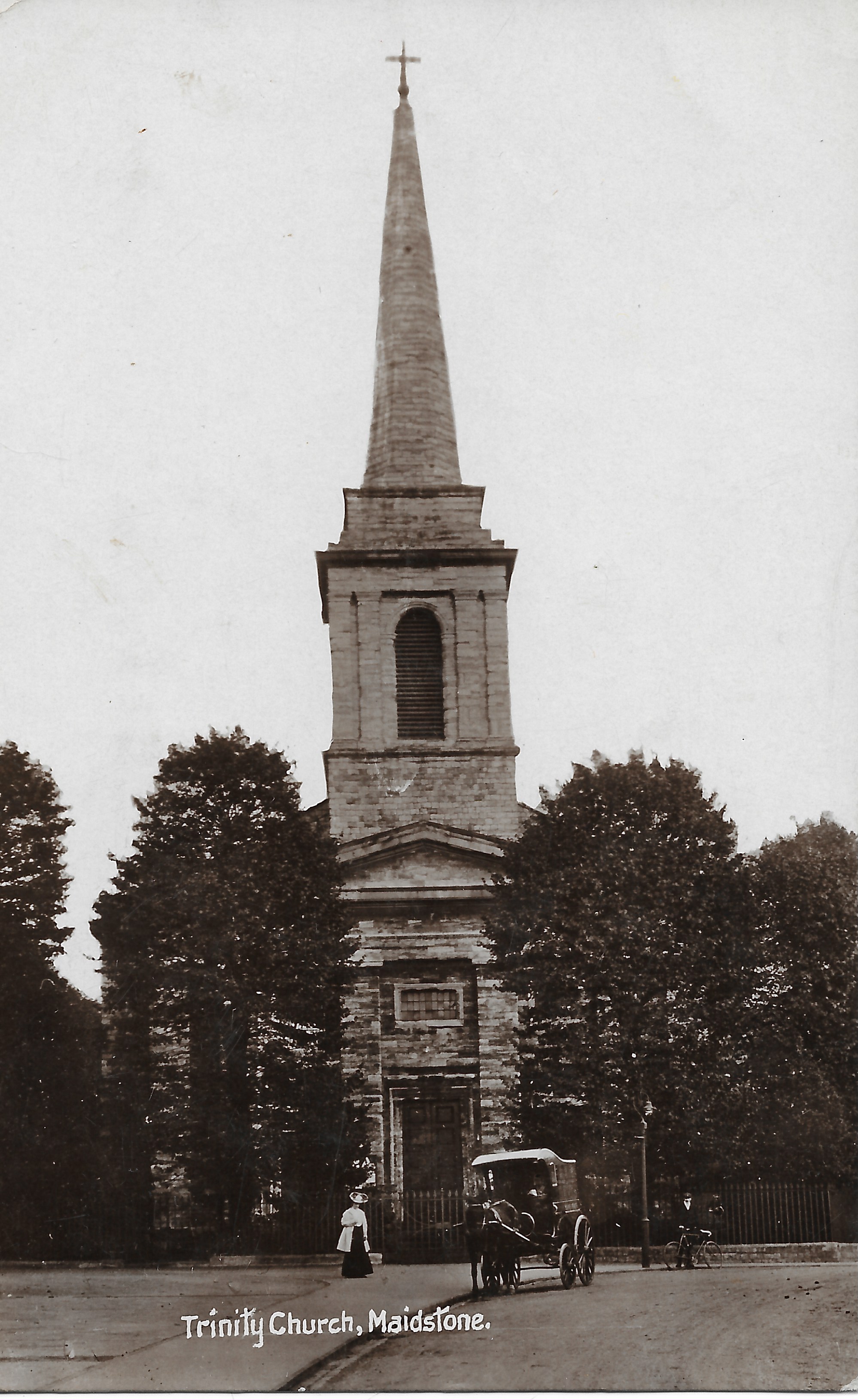
Mr Wagon produced a plan which showed the road leading by the side of the water, the wharf and the land about Preston Hall. He stated the road was a private foot road and that the deceased and any other persons by driving on it, committed a trespass, and were liable to a penalty of 40 shillings. Mr Freeman (land steward to Mr Betts) confirmed the road was private and the gate through which the deceased had come was generally kept locked. Mr Wagon stated that at the Quarter sessions, Mr Betts obtained an order to stop up the road and make a new one at Little Preston, which was to be gravelled six inches deep. The road was especially dangerous since the new railway had been opened.

Thomas Rayfield identified the bodies of the deceased and stated that Thomas and his father went to the wharf on friday to inquire about some quoins (corner stones) for a building, which Thomas was erecting. They left home together about six o’clock, but the father parted with the son on the road and the latter drove to Maidstone. The father was to meet him again at Aylesford.

William Baker, a blacksmith of Aylesford, said that at half past four on saturday morning, he was walking along the tow path, when he saw a horse lying in the water. The horse was on it’s back. He went to the spot with his mate, and the captain of a barge took a boat and rowed to the spot. They made lines fast to the chaise, and pulled it out of the water, and they towed the horse down to the bridge and made it fast to a barge. The horse was “quite dead and stiff.” He then helped search for any bodies.

James Finch, a mariner of Maidsone, stated he was walking down from Maidstone to Aylesford on saturday morning about half past five, and hearing of the accident, hastened to the spot. Constable Hilton had been sent for and drags were used close to the spot, where the chaise entered the water. Two bodies were recovered. There was a footpath at the place, but he had often seen carts pass over it. When he first knew the spot, the road ran about 15 yards farther inland. The bodies were taken to the George Inn. It was high water on Sunday evening at half past seven and the water ebbed very fast for about two hours.

Israel Elliott, who was employed by Mr Garnham, at the stone quarry, stated that he knew Thomas Shilling and that he came to him at the stable on the wharf on friday night, a little before nine o’clock. He left his chaise at the gate and walked to the stable. As Mr Garnham was not there, he said he would return. He returned to the gate, where he had left his horse, Israel told him that a train was coming along soon and asked him, if his horse would take fright. Thomas Shilling, stated that  he had left the horse with another man, as the horse could not be trusted by itself. Israel stated that he judged that the train from Maidstone would have arrived at the same time Thomas Shilling had walked back to his horse. He saw him again, twenty minutes later, when he passed along the stone wharf.

William Smith of New Hythe, stated he was gatekeeper at Preston gate and on friday night, he saw Thomas Shilling come from Aylesford, between the river and the rails.  He went to the stable and after a time, returned to his chaise, which he had left about three rods from the gate near the level crossing, and there was a person in it. He did not see him get into the chaise, about six minutes after he left, he heard the train come by. The train whistle was sounded just before the level crossing and again before the station.

From the evidence it was concluded that as the gate was locked, Thomas Shilling had left the chaise  at the gate and walked to the stable on the wharf. On his return, he was seen to mount the chaise, and drive along the path back to the first gate, and it was supposed that the train overtaking them, and there only being a hedge between the path and railway, the horse was suddenly frightened, and by backing up, perhaps only a yard, the chaise, horse and men, were in a moment precipitated over the bank into the river, the accident occurring about midway between the two gates.

Constable Hilton produced a watch, which was found on the body of James Shilling, which had stopped at 18 minutes past 9, the station master at Millhall had informed him that the train passed there at 12 minutes past 9. Ann Shaw, wife of Samuel Shaw, who laid forth the deceased stated that the only mark, she observed was a slight mark on the forehead of James Shilling.

The Coroner said there was no doubt the deaths of the unfortunate men were caused by accident. The same horse was nearly burned to death at the fire, which took place on the premises of Thomas Shilling at Malling, a short time back and it was probable that, seeing the fire of the engine as the train passed along, it was much alarmed and dashed into the river.  There could be no doubt the road was dangerous, but as it was private, there was no necessity to fence it. So far as carriages were concerned it was a private road and with the question as its being dangerous to foot passengers, it would no doubt be remedied by Mr Betts. To prevent a recurrence of such an accident, he would recommend the gates should be kept locked. No doubt Thomas Shilling got into the chaise and fancied he should be able to drive from the dangerous point before the train got up to him. The foreman said if Thomas Shilling had been able to reach the bend in the road, there would have been more ground to have managed the horse in, and he might probably have been pulled up. The jury returned a verdict of “Accidentally drowned.”

Both  men were insured in the Railway Passengers and General Accident Assurance Company for £1000 each. Thomas Shilling left a widow and four children, who by such measure provided for, as they would come in for the whole amount of the double insurance.

James and Thomas Shilling were both buried at West Malling on 17th July 1856.

A twist in the tale – the widow of Thomas Shilling, Charlotte Shilling brought an action against the Accidental death Insurance company in March 1858, to recover the sum of £2000 on a policy for her father in law James Shilling. The company pleaded that they never made the policy and that the plaintiff was not the administratrix of  James Shilling, and at the time the policy was effected, James Shilling was subject to fits and was ruptured, circumstances unknown to the company and the policy was obtained by fraud. The policy was obtained for the sole benefit of Thomas, the son of James Shilling and that James Shilling had wantonly exposed himself to the dangers which resulted in his death. Mr Sergeant Shee addressed the jury, the principal point was that the insurance effected on behalf of the deceased James Shilling was not a bona fide insurance by him, but the insurance was effected by his son Thomas Shilling, for his own benefit, and that the other had no interest in the matter. A number of witnesses were examined to speak to certain statements made by Thomas Shilling to that effect, and evidence was also adduced to show the James Shilling was subject to fits and other ailments, which had been kept from the knowledge of the company at the time, the insurance was effected. Mr Justice Erle, in summing up, told the jury that the statute of the 14th George lll was passed expressly for the purpose of preventing persons effecting insurances upon the lives of others for their own benefit, and he observed that it was obvious that if a person was allowed to effect an insurance upon the life of another without the knowledge or sanction of that other, such a proceeding was calculated to lead to a good deal of crime and the object of the legislature was to repress such a course of conduct. The learned judge then called the attention of the jury to the facts of the case as they appeared in evidence and said that it they were of the opinion that the insurance was effected by the son, Thomas Shilling, without the consent or knowledge of his father, and with the view that he, himself, should alone derive advantage from it, the defendants were entitled to a verdict upon the plea, which alleged that the insurance was a wagering one and not effected for the benefit of James Shilling but for that of his son. The jury almost immediately returned a verdict for the defendants!

Stealing books with a child.

At the Maidstone Police Court, James Jackson, an old man who had served in the army, was charged with having stolen five books, the property of Mr John Woollett, a book binder of Mill Street, Maidstone.
Police Constable Payley, of the Tunbridge Wells force, stated that on 9th March 1861, he saw the prisoner at Tunbridge Wells,  with a small boy. The boy was carrying a small bundle of books, which he told the witness, he had been given by his mother that morning. The witness asked where his mother was and the boy stated that he did not know and was trying to find her. The prisoner Jackson was standing by and heard the conversation and the witness asked Jackson, “is this your boy?” to which Jackson denied knowledge of the boy. The witness then said “You had a boy this morning with you in Tunbridge Wells” to which Jackson, then replied “I know, this is him” Police Constable Payley then took them both into custody on suspicion of having stolen the books.
Kate Woollett, wife of the prosecutor, deposed that between six and seven o’clock on the evening of thursday 7th March, she had occasion to go into the shop, when she saw the prisoner outside of the door. He had hold of the door,trying to pull it gently to. She had not heard the bell ring and she told the prisoner to come in, if he wanted anything, and then called her husband and waited until he came. Mr Woollett identified four of the books, as his property and that the prisoner, came to his shop. Mr Blundell applied for a remand in order to complete the case, however the prisoner pleaded guilty and requested to be dealt with summarily. He commenced crying and stated that he had recently recovered from a fever and it was entirely from, that want, that he had stolen the books. The bundle taken from the boy also contained several knives and another book, not belonging to the prosecutor.
Mr Blundell stated that he had found from his inquiries, that the prisoner had been travelling about the country with the boy Wilson’s mother, who was committed to the Maidstone gaol for stealing a blanket at Chatham. The prisoner was sentenced to two months’ hard labour and the boy, who no evidence was offered against, was ordered to be taken to the union workhouse.

Home

Fatal fire at Shernold Pond Farm.

On friday 23rd August 1833, between eleven and twelve o’clock in the evening, a fire broke out in the farm buildings of the Shernold Pond farm, part of the Boughton Mount Estate, near Maidstone, belonging to the trustees of the late John Braddick and entirely consumed the barn, oasthouse, cattle lodges and fruit room. The fire originated in part of the buildings where some new charcoal had during the day, been deposited, and there was no doubt it started from latent fire in the charcoal. Mr Kemp, the tenant of the farm and a lad, about 16 or 17 years old, were out on the land and amongst the buildings, watching the fruit plantation, which were constantly being robbed and the lad’s master told him to go and lie down for a short time, whilst he went round the grounds. In less than half an hour, he saw the buildings, in which the charcoal was deposited on fire and gave the alarm, but so rapid was the progress of the flames, that before the engines from Maidstone could arrive, the whole range of buildings were on fire. The poor boy was found lying in a sleeping position, dead in the lodge, at a considerable distance from the point where the fire started, he was burnt and disfigured and there was little doubt that he had suffocated long before the fire reached him.The house and stables were saved and it was miraculous that the thatched farm buildings belonging to the Swan public house, close by, escaped the fire. The buildings destroyed were insured in the Kent Fire office for £250. The tenant who was a young industrious man, lost four pigs, two quarters of oats in the straw and various farming implements, none of which were insured, but was fortunate in saving his horses, cows, some pigs and his waggons and carts. A play fellow of the lad who was burnt, was discovered dead in the orchard, suspended from one of the trees, and afterwards fell to the ground. It was rumoured that his suicide, was in some way connected with the fire, but this was not the case, as the suicide was committed some time, before the fire broke out.

The sad story of the Birch family.

The South Eastern Gazette of 12th December 1854, reported the suicide of Elizabeth Birch, aged 29, the daughter of Samuel Birch, a grocer of King Street on 10th December 1854. Her death, the result of taking three ounces of laudanum, procured from a bottle in her father’s shop, where the drugs were sold. The Gazette described Elizabeth as having been “addicted to dissolute habits for some time.” The inquest which was held on 12th December at the Royal Oak Inn, before the coroner T. Kipping.

The first witness James Thornington, a farm baliff living at Grove Court, King Street (which was situated at the back of the house of the deceased) stated that on returning home on the evening of saturday 9th December, the deceased was in his home and had been sleeping there during the week. He described her as looking “very strange and crying bitterly, claiming that her father would imprison her, for robbing him. He stated that he told her, that he would go to her father and endeavour to induce her father, to alter his intention. He however did not visit Samuel Birch, that evening. That same evening at about eight o’clock, Sergeant Hills took a summons to Samuel Birch’s house, and James Thornington’s wife informed Elizabeth Birch, of the summons. Elizabeth cried bitterly and could not be pacified, and stated she wanted to go out, with the intention of drowning herself. James Thornington, however, prevented her from leaving. On the Sunday morning, she was still in a distressed state and begged James to go to her father, which he immediately did, at about half past ten. After he had been talking to Samuel Birch, for about five minutes, Elizabeth entered the house. Her father Samuel said to her “You are a pretty creature, ain’t you, to bring me to poverty in my old days.” Elizabeth expressed her sorrow for what had occurred, but said if her father would forgive her, she would get the things back, as soon as possible. Elizabeth, then went into the shop, to where the medicine bottles were placed. She then went upstairs, to come down again and return to the shop. During this time, James was trying to persuade her father Samuel, to forgive her. James then heard some bottles rattle, and immediately ran to where Elizabeth was at the counter, on which she had put a glass. James asked her “Betsy, what you done?” She took him to the corner, where the bottles were placed and pointed to one, containing laudanum and a glass, which  had been filled. He gave an alarm, and Samuel Birch ran into the street and meet Dr Power, who came in. James further stated that Elizabeth had told him on the saturday, that she had pledged her father’s things, a great many times, including his watch and could not get it back and that she owed Mrs Budgen of Paradise Row, £4, 19s 6d. He had never seen Elizabeth, the worse for liquor and did not think, she was inclined to drink. She pledged her father’s belongings, to screen the faults of her sister, who was a habitual drinker. She had borrowed money from Mrs Budgen, to redeem her father’s articles from the pawnbrokers, which she has pledged to pay her sister’s debts, she pledged the things on Monday morning and was to redeem them on the following saturday, for her father’s use on Sunday.

The witness Doctor Power stated he was passing the deceased’s house at about quarter to eleven on the sunday morning, when he was told by Samuel Birch, that his daughter had taken laudanum. He found her sitting in a chair and asked her, what she had done. She said she had taken a glassful of laudanum, which she obtained from her father’s shop. Doctor Power was surprised to find the laudanum for sale in the shop. She said her father  had taken a summons out against her, and she was afraid, she would go to prison.

Doctor Power administered a mustard emetic and procured a stomach pump from his surgery, after the use of which, the deceased become comatosed. Doctor Power stated, that with his assistant, they had applied stimulants, friction to the chest and other parts, and she was shaken with the assistance of the police. She was also pricked with needles, at the back of the neck,    and they resorted to various other means to revive her, but she sank into a state of torpor, which continued to her death, the same afternoon.    The glass in which she took the laudanum held four ounces and there was no doubt that it was the cause of her death, causing congestion of the vessels of the brain. Dr Power had attended to the family for twenty years, and he had never thought her of unsound mind. In conclusion, Mr Power stated that he wished to call the attention of the jury to the great impropriety and danger in allowing persons to sell poisons, the deadly nature of which, they were unaware of, in such small shops. In Samuel Birch’s shop, there were a number of deadly poisons, the bottle of laudanum  produced at the inquest, was marked 4d per ounce, which quantity was sufficient to kill any person and it was evident that any one could obtain it, by the payment of 4d. Poisons given to infants, sold at such sheps, in the smallest quantities would often result in death.

The coroner in summing up, said there was no doubt as to the cause of death and the only point to consider was her state of mind. The only evidence to be considered was that of James Thornington, and if necessary, he could call the father. With respect to the advice of Dr Power, he observed there was no law to prevent persons selling poisons, with the exception of arsenic. The jury returned a verdict of “That the deceased destroyed herself by taking laudanum, while in a state of temporary insasnity” at the same time expressing their opinion that every means ought to be taken to prevent the sale of poisons by parties, unacquainted with their nature. Elizabeth was buried in the Holy Trinity church, on 15th December 1854.

A further tragedy followed on 22nd January 1855, when Samuel Birch’s wife Elizabeth also committed suicide. Samuel Birch was now in debt and the Mayor and other gentlemen were hopeful that they could re-establish Samuel in business, and were about to set a subscription, first obtaining a release of his debt from the creditors, who he owed money to. However one creditor refused to release Samuel from his debt and the subscription was not proceeded with, as it was deemed unadvisable to raise money for a creditor, who threatened to take proceedings to recover his debt. In consequence of their forlorn circumstances, Mrs Birch committed suicide. On the day in question, Mr and Mrs Birch had breakfasted together, when at about ten minutes past ten, Samuel left the room for a short time and on his return, he saw his wife coming down the stairs, holding her apron to her throat, from which blood was streaming, she twice exclaimed “Lord have mercy upon me!”. Mr Birch, immediately ran across the road to fetch the surgeon Mr Allwork and his assistant. A fearful gash was found in her throat, entirely severing her windpipe, the wound inflicted by a large carving knife. She had stood in front of a looking glass to inflict the wound, and held her head over a commode, allowing the blood to flow into it.  At the inquest, Samuel Birch stated that his wife had frequently of late, talked about Mr Fulljames, saying what a bad man, he was and talked during the week of their money problems. Samuel Birch had told Mr Fulljames, that he would be the death of his wife. She had attended the Trinity Church on Sunday afternoon with him and seemed much better in spirits, than previous days, but on the Monday morning, she had spoken again to Samuel, of their difficulties. On the previous thursday, Mr Fulljames sent for Samuel Birch, and told him he wanted £10 or he would sue him for the debt and costs. Samuel told him, that he has seen the Mayor and Mr Austin, respecting his affairs, but again Mr Fulljames repeated his former demands. Mr Fulljames had put an order into the house before and it was in force, when his daughter committed suicide and his goods were being lotted. He had told his wife of Mr Fulljames’ demands and his wife was upset. She often said Mr Fulljames was a very bad man and she also spoke of her daughter Mary in prison. On the Sunday afternoon, they had taken tea with a relative Mr Foreman, again after which she spoke of their troubles, several times, she wanted Samuel to go to Mr Fulljames on Monday morning, respecting his debt and the threatened order, but he told her, it was of no use, going to him again, as he had been several times, before.

The witness Mr Allwork, surgeon, stated that he attended Mrs Birch and on entering the house, found her in a back bedroom, on the bed with a severe throat wound, she was apparently speechless and gasping for breath. He found the windpipe, nearly divided, but the principal arteries had been missed. It was evident, that she was suffering from suffocation, in consequence of the blood having passed down the windpipe. He passed a tube down the windpipe, through which she was enabled to breathe with some temporary relief. Dr Power then arrived and everything was done to save her life, but she died about half an hour, later. A carving knife covered with blood was on the drawers and he has no doubt, she inflicted the wound, before the looking glass and went to the commode and held her head over. The looking glass was sprinkled with blood and there was a large quantity in the commode.

Sergeant Hills stated that he went to the house and confirmed the evidence of Mr Allwork, he also examined the stairs and found a few drops of blood on them, and on the cellar door below, he found a bloody hand print. There were other marks on the door and he had no doubt, that the deceased committed the act.

The coroner stated that he thought there was no doubt from the evidence, who had inflicted the wound and only other point was the condition of her mind at the time. Looking at the circumstances of the family; a daughter having recently committed suicide, another daughter in the gaol for misconduct, and the proceedings about to be taken, it was not surprising that such an accumulation of misery should have unsettled the mind of the deceased and the jury returned a verdict of temporary insanity. Elizabeth Birch was also buried at the Holy Trinty church yard on 28th January 1855.

The Maidstone Journal acknowledged the kindness, of all the creditors, especially Charles Arckoll, the largest debt of all the creditors, who was one of the first to express his willingness to release the unfortunate Samuel Birch, from his debt and Samuel publicly expressed his thanks to his creditors and to the other gentlemen and ladies, who had afforded him relief. A subscription list was opened at the office of the Maidstone Journal and any funds would be appropriated towards the future permanent relief of the unfortunate man.

Mary Birch, the other daughter, mentioned at the inquests, was charged at the Maidstone Police Court on 2nd January 1855, for having been drunk and disorderly that same morning. She was described as bearing the marks of deep dissipation in her countenance and from her manner and looks, she seemed some what disordered in her intellect. She appeared in court, in the mourning dress, that she had donned for her late sister. The case was proved by Inspector Fancett and Sergeant Sunnucks, who both saw her in a riotous state of drunkeness, earlier that morning. Inspector Fancett stated she was in the habit of getting drunk and had frequently given the police much trouble. She was fined 40 shillings, and in default, one month’s hard labour. Mr Randall hoped that her imprisonment and hard labour, would bring her to her senses. Her parents were respectable people and she ought to have reflected on the recent death of her sister. The bench thought it was charitable to commit her to hard labour for a month, in the hope that punishment might reclaim her from her shocking propensities. In 1861, Mary is living with her brother also named Samuel and his family at Sutton Valence. The younger Samuel was also a grocer and draper. Their father died on 9th April 1858 at Sandling Road, aged 68 years, he was also buried at the Holy Trinity church yard on 13th April 1858.

Scan_20200101 (9)

Maidstone – Celebration of Peace 1856

The 29th May 1856 was described by the Maidstone Journal as a memorable day in the annals of Maidstone. The recollections of which were not  however based  on the event – the Treaty of Paris 1856, which gave occasion for the feasting, but the celebrations which had thrown the nation into the ‘paroxysms of joy and triumph’ and all felt that the peace was an ‘inestimable blessing’ and it would be wise to mark it’s return by festivities, which would give the ‘rising generation’ an idea, that the cessation of war, was an event at which all men ought to rejoice. The mayor H. Argles convened a meeting, of gentlemen of all sides of politics and religion to consider the matter and it was agreed that there should be public rejoicings, the principal feature to be a treat to all the school children of the town, and if Lord Romney’s permission could be obtained, it was thought that tea and plum-cake in the park, would form a very satisfactory celebration. There would be a procession and it was suggested that clubs and other societies might wish to display their flags and regalia and with the assistance of the military, besides showing respect to the brave army, it would bring a grand ‘feu de joie’ in the High Street, that would impress the youngest child present, more effectively than almost anything else could do. The cost would be about £300, and it was thought that the inhabitants, would willingly contribute. A sub-committee was formed and plans drawn up and modified, the ‘feu de joie’ could not be fired in the High Street and a dinner for soldiers, who had served in the Crimea, would be given in the park.

On the day, the morning dawned amidst fog and and mist, but towards seven o’clock, the glorious sun dispelled the watery vapours and for some hours, the sun shone brilliantly, giving the promise of a magnificent day. The festive character of the day was announced by merry peals from the sweet toned bells of All Saints church, which at intervals poured out their floods of cheering melody, until two o’clock.

By nine o’clock, the streets were thronged with sightseers and by eleven o’clock, it was difficult to move about in the High Street, which formed the centre of attraction. In all directions, flags and banners were displayed, with the royal arms displayed over Mr Oakley’s shop, the Journal’s office exhibiting the banner of the Constitutional Society, with the motto “Prosperity to British Industry” and the splendid new Alhambra front of Messrs Payne, Evenden and Lewis had an appropriate finish by a profusion of national and patriotic flags from the windows. The upper part of the High Street was set out with spaces and placards, indicating the spaces for the various schools to wait in place for the commencement of the procession. The schools present were the British National School, The Trinity Church Model National School, Tovil National School, The Mote School, St Peter’s School, The Garrison School, Independent School, Wesleyan School, King Street Sabbath School, Bluecoat School, All Saint’s National School, Girls’ British Day School, Zion Chapel School, Bethel School, Salem School, Unitarian School, Miss Bishop’s School, Sir Charles Booth’s School, St Faith’s School, Bonny’s yard School, Shernold School and Coxheath Union School. The scene was described as one of the most animating and magnificent that Maidstone probably ever saw. Viewed from the Town Hall, where a large party of ladies had assembled, the whole expanse seemed a forest of flags, including a large banner carried by the All Saint’s National School, representing the arms of the Romney family. The All Saints School had no fewer than 35 large flags, besides a multitude of smaller ones, carried by each child. The effect was that of a waving forest of brilliant coloured branches, swaying to and fro, and displaying an underground, as it were of happy cheerful faces. This was fringed around by the tall forms of the gallant fellows who had fought or would have served in the Crimea, if the opportunity had risen. Shortly after the schools had taken up their positions, the military arrived from the barracks, under the command of Colonel Balders. Preceded by the band, they entered the High Street by the Mitre yard and marched in single file, encircling the waiting school children. The Marine Band which arrived, shortly after were positioned at the end of King Street and the Depot Band remained at the Town Hall. All the windows of the surrounding buildings, were crowded with well dressed ladies and the tops of houses with gentlemen.

At half past twelve, the various clubs assembled in the lower High Street, including the Ancient Order of Foresters, with their banners, one depicting a widow and child lying at the side of a newly made grave and another depicting an old soldier shielding a wounded younger comrade, probably his son, from further harm, whilst lying on the snow covered ground. Other clubs included the Loyal Order of Odd Fellows, the Hand in Hand Benefit Society, the Ancient Druids, Members of the Friendly Society of the Market House, and a strong muster from Tovil of the Philanthropic Society and the Men of Kent.

At one o’clock the Mayor H. Argles, attended by the Town Clerk and accompanied by the aldermen and councillors of the borough, ascended a platform erected at the Town Hall,  with the mace bearers and their golden charges at either end, facing the children. Despite a heavy shower ensuing, the children and members of the Maidstone Choral Society, accompanied by the Depot Band, with Corporation and other inhabitants, sang the “Hundredth Psalm” The Maidstone Journal stated “the effect was most imposing as the multitude of the youth of the town with one consent and in excellent harmony raised their cheerful voices to their maker in devout acknowledgement of his supremacy.” This was followed by the Mayor reading her Majesty’s proclamation of peace, followed by the National Anthem, sung by the children and other vocalists, accompanied by those assembled in the High Street. As the anthem finished, to the tune of the “British Grenadiers” played by the Marine Parade, the procession moved off towards the direction of Mote Park, followed by many of the town’s inhabitants. They were followed by twenty waggons dressed with laurels, containing groups of children from the infant schools, too young to endure the fatigues of the journey on foot. They were greeted along the route, by loud cheers from the spectators. The children were transported from Messrs Tassell’s yard in the West Borough, the vans lent by the railway company and several tradesmen of the town.

The scene in the park was described as of ‘varied but of an intensely interesting character.’ The children on arrival were marched to their respective places in the tea circle and the clubs to the lodges provided for their reception. A battery of cannon from the Stone street brewery fired royal salutes, during the afternoon and an archery ground attracted many spectators. An acrobatic performance, to the inspiring strains of the Loose Band was much admired and a variety of other sports were presented. Stalls provided drinks, some of a strong character, but no drunkenness or disorder was found in any part of the park. Despite the rain, it seemed many enjoyed the event. The south side of the park, which was occupied by many carriages filled with elegantly dressed ladies, the grass having become too wet to walk on. The Journal stated the circle around the quadrille band was always filled, and ‘occasionally a fair one was seen, in search of a truant swain to whom she was engaged to dance: whilst he, forgetful of his promise, was fortifying himself against the damp, in one of the booths or perhaps (we blush for our sex while writing it) having made the engagement without the slightest intention of fulfilling it.’

The arrival of the younger children in the waggons was greeted by a loud cheer from the older children and after each waggon had deposited it’s living freight, the ringing of a bell attached to the tent, caused a scene of the most lively bustle and excitement, that signalling the commencement of tea. The half pint pots were first served and the by no means ‘Lilliputian slices of plum-cake’ rapidly disappeared from the table. During the this time, the clergymen, ministers and teachers were fully employed in satisfying the wants of their young charges. A reverend gentleman could be seen hurrying round with a can of tea, another supplying the juvenile feasters with plum-cake, but all evidently ‘actuated in their labour of love by a hearty goodwill, and joy and happiness reigned supreme in all countenances.’

At the close of the feast, many persons who had no right to participate crushed in and the excitement, therefore prevented the music committee carrying out their singing of patriotic songs. Later in the evening, each child was given an orange and cheers were given for the Queen, Earl of Romney, Lord Marsham and the committee. The Crimean soldiers at the Depot were specially feasted, a grand cricket match was played and the evening closed with a grand display of rockets and Roman candles and a tremendous bonfire on Debtling hill.

Home

The Plague in Maidstone

The Plague in Maidstone.

According to J.M. Russell’s “History of Maidstone” the plague frequently visited Maidstone. The first known details were in 1544, when five members of one household Joan, Alice, Gervase and John Nash, and Alice the mother died and were buried within a fortnight. The plague again broke out in the autumn of 1562. The town crier went round the town and announced that the Michaelmas Fair, which was being held, could not be continued; because of the pestilence. Communication with London was immediately suspended and strangers fled to their homes. Public meetings were prohibited and All Saints Church was closed and marriages were postponed and infants were taken to Otham and Loose for baptism. In the following year, about a hundred and fifty inhabitants died from the plague, seven buried in one day. There were more deaths in 1574 and also in 1578, when seven members of one household were buried within six days, interred in All Saints Churchyard. In 1579, about forty persons succumbed to the plague. There were further partial outbreaks in 1589 -1591. In 1591,the sanitary state of the town was so poor, that the Mayor and Jurates attempted measures of relief, an order was issued to the people living in the almhouses in Stone Street, Pudding Lane and on the bridge, that “if they continued to keep hogs or swine in the rooms or houses where they lived” they would each be fined, at the discretion of the Mayor and four of the Jurates; 3 shillings 4d, “to be levied by the sale of the said hogs or swine.” About thirty deaths occurred in 1592, and a byelaw in October 1592, imposed a fine on the owners of pigs found wandering in the streets. The out breaks of plague continued and in 1595, the borough chamberlains paid 6 shillings 8d for the burial of William Ellis and his wife and 4d for the burial of Kate Durrant. Fifty persons died in 1594, forty in 1596 and sixty five in 1597.  The plague was once more prevalent in the autumn of 1602 and in 1603, the death toll was for 1602 was 112.  Great difficulty was experienced in obtaining nurses for the sick and the almhouses were living in charity and without occupation, the Corporation ordered them to admit into their rooms and to wait upon the desperate cases. At the same time, the owners of pigstys which has long existed on St. Faith’s Green were ordered to have them removed. The precautions however produced no abatement in the excessive mortality, twenty five persons died in 1604 and sixty two in 1609. In 1614, there were ninety one deaths. There were further outbreaks in 1615-16 and in 1625,the Mayor and the Jurates issued an order that “no hoyman, foot or horse post, should, during the infection in the Metropolis, carry or receive any goods from Maidstone to London, under a fine of £5; and no inhabitant was to take or lodge any stranger from London or other places. By the August of 1625, the pestilence had subsided and a public fast was held, but in 1626-7 the deaths were again numerous. Forty persons died in 1634 and in 1636, when the plague was raging in London, the Corporation posted seven watchmen at the chief entrances to the town with orders “to keep all suppositious person” coming into the streets.

On 18th October 1665, Sir John Banks, of the Friars, Aylesford wrote to Samuel Pepys, of the Admiralty, entreating his interest with the Duke of York, on behalf of a letter from gentlemen of Maidstone, praying that sick men might not be sent from the fleet, as Maidstone was the only town, free of the plague. he stated that the militia and one of the duke’s troops were already quartered in the town and pointed out to remove disabled men thither “would be a great inconvenience.” On August 27th 1666, it was reported in London that the plague was “very hot in Maidstone.” Fearful havoc was wrought amongst the prisoners in the County gaol, High Street and it was found expedient to use the George Inn, East Lane (now King Street), as a temporary prison, where three of the prisoners died. A pest house for the reception of the sick was opened, and many perished within it’s walls. To add to the horror, two principal surgeons, William Cox and Nicholas Bennett died at the time, though not of the plague. In the last week of August, nineteen victims were buried in one day, the mortality rate was seventy, for that month. In September 106 deaths were recorded, October 110, November 24 and December 32. In total inn1666, 347 lives were lost to the plague and another 136 from other causes. The plague last attacked Maidstone in the summer of 1667, there were 33 deaths in June, 42 in July, 30 in August, 12 in September, 14 in October, 2 in November and 3 in December, 154 in total. There was great distress in the town and the Archbishop of Canterbury sent £20 to John Davis, incumbent of All Saints; for the “poor and afflicted of Maidstone”.Home