At the Maidstone Police Court on 11th January 1859, before the Mayor C. Arkcoll, William Hills, 31, captain of the barge “Albion”, Joseph Hills, 38, mate and Alfred Burr, second mate, was charged by Mr John Smythe with stealing several gallons of stout from the barge of which, with it’s cargo, they had charge of. Mr Smythe stated that, from information he received, he communicated with the owner of the barge “Albion”, Mr Masters, who went with him to the barge, which was unloading at the Albion wharf. The vessel was freighted with stout, which had been obtained from Messrs. Truman and Hanbury’s wharf, London. Mr Smythe asked the captain, if he had got any beer on board in stone bottles or casks, when he replied “Not a drop.” The witness then went to the forecastle, when he saw Burr slip into the cabin, he followed him and immediately perceived a strong smell of porter, and he observed that the grate was swimming with the liquor, at least two or three quarts. Burr admitted pouring it out, because they might fancy it, was their beer. The barge was then searched and under a bed in the stern of the barge, two large stone bottles filled with beer were discovered. The police were called and in total about twelve gallons of beer were found and the prisoners were taken into custody. Captain Hills stated that he was innocent and denied that he knew there were any beer in bottles in the barge or that anything was placed under the bed. The others also denied the charge.
Mr Smythe said that large quantities of beer had been previously lost from the same barge, as much as 40 gallons out of two puncheons. The prisoners had formed the crew of the barge at that time , but the previous captain had since died. The prisoners were remanded to saturday 14th January.
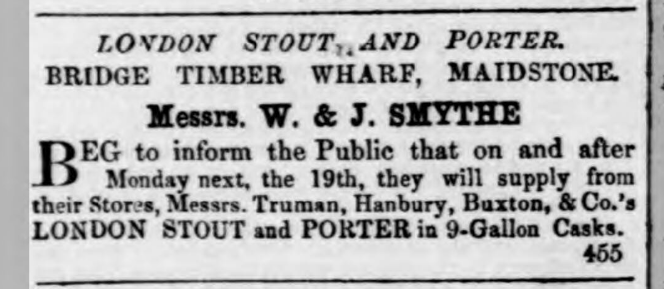
At the next session, John Smythe was called, he stated he carried on the business of a porter merchant, in Maidstone, in partnership with his brother, and was supplied from the firm of Messrs. Truman and Hanbury, London. He contracted with Messrs. Masters and Son, for the delivery of stout and porter from the Black Eagle Wharf to the Albion Wharf, Maidstone. He supplied several customers with porter and stout, some of which were delivered by rail. He had received complaints from customers, that had been supplied with porter from the “Albion” barge. On the day in question, he had discovered liquor in the ashes of the grate and bottles concealed under the sleeping berth. On the following day, on a further search of the barge, a piece of gutta percha tubing bent to the shape of a syphon was found. It was wet and and smelt of beer, and also a quantity of spiles and corks were found tied up in a handkerchief and a piece of gutta percha tubing, a plug, hammer and three gimlets. These were concealed under the floor of the sleeping berth.
Mr Joseph Marriott Hancock, foreman to Messrs. Truman and Hanbury, said he examined certain tasks at the stores of Messrs. Smythe, and as far as the quantity of porter contained in the casks, there was not much astray with the exception of one of the barrels, which was about three quarts short. But the stout in some of the casks was greatly deteriorated, on examining the stoat that had been found in the bottles, he believed it to be genuine and the same in quality, as when sent from the brewery. On examination of the casks, he thought some of the corks had been removed, and in two of the barrels, he noticed the corks had not been put in the same way as their cooper put them in, and had been driven in by an inexperienced person. The stout sent to Messrs Smythe was all from the same brewing, and drawn from one vat.
Henry Herrington, in the employ of Messrs. Truman and Hanbury, said it was his duty to direct the casks and also to sound all casks prior to them, leaving the brewery, and on Saturday 8th, there was a quantity of casks, which left the brewery consigned to Messrs Smythe, Maidstone, which he believed to be full, when they left their stores, and the casks containing stout, he swore postively were quite full, as he had sounded them himself, and had good reason to be careful with the stout, as he had been cautioned by his master to be able to swear that the casks were full when delivered from their stores.
Mr Charles Barrett, deputy foreman to Messrs. Truman and Hanbury, deposed to shipping on 8th, at the Black Eagle Wharf, on board the “Albion,” 21 puncheons, 40 barrels and 30 kilderkins, all of which appeared to be in the usual good order, and gave them into the charge of the captain, William Hills.
William Masters, wharfinger, said the prisoners had been in his employ and that he was engaged by Messrs. Smythe to bring stout and porter from the Black Eagle Wharf, Wapping to Maidstone. William Hills had been in his employ for many years and J Hills, had also been employed for a long time, but not so long as the former and he had always allowed them money to get beer with.
Mr Goodwin, for the defence, addressed the bench, and contended there was not sufficient evidence to convict the prisoners, there being only three quarts of stout missing, from such a large quantity.
The prisoners were committed to take their trial at the next assizes, and on application they were ordered to give bail in £100 each and two sureties of £50 each, with 48 hours notice.
At the Spring Assizes on 18th March 1859, William Hills, the captain of the barge, Joseph Hills and Burr were all found guilty. His Lordship in sentencing them, said they had been convicted on the clearest evidence of a most serious offence, that of having taken advantage of being entrusted with a cargo of stout and porter; to abstract from it a considerable quantity, and what was an aggravation of their offence, in order to make up the deficiency, they had spoiled in a great measure the remainder. It seemed to him that William Hills as the captain of the barge was the worst offender and he was sentenced to eight months’ hard labour and Joseph Hills and Alfred Burr to six months’ hard labour.
 Grim crimes and unfortunate events in Historic Maidstone