The Denniss Paine shop fire – Saturday 17th December 1910
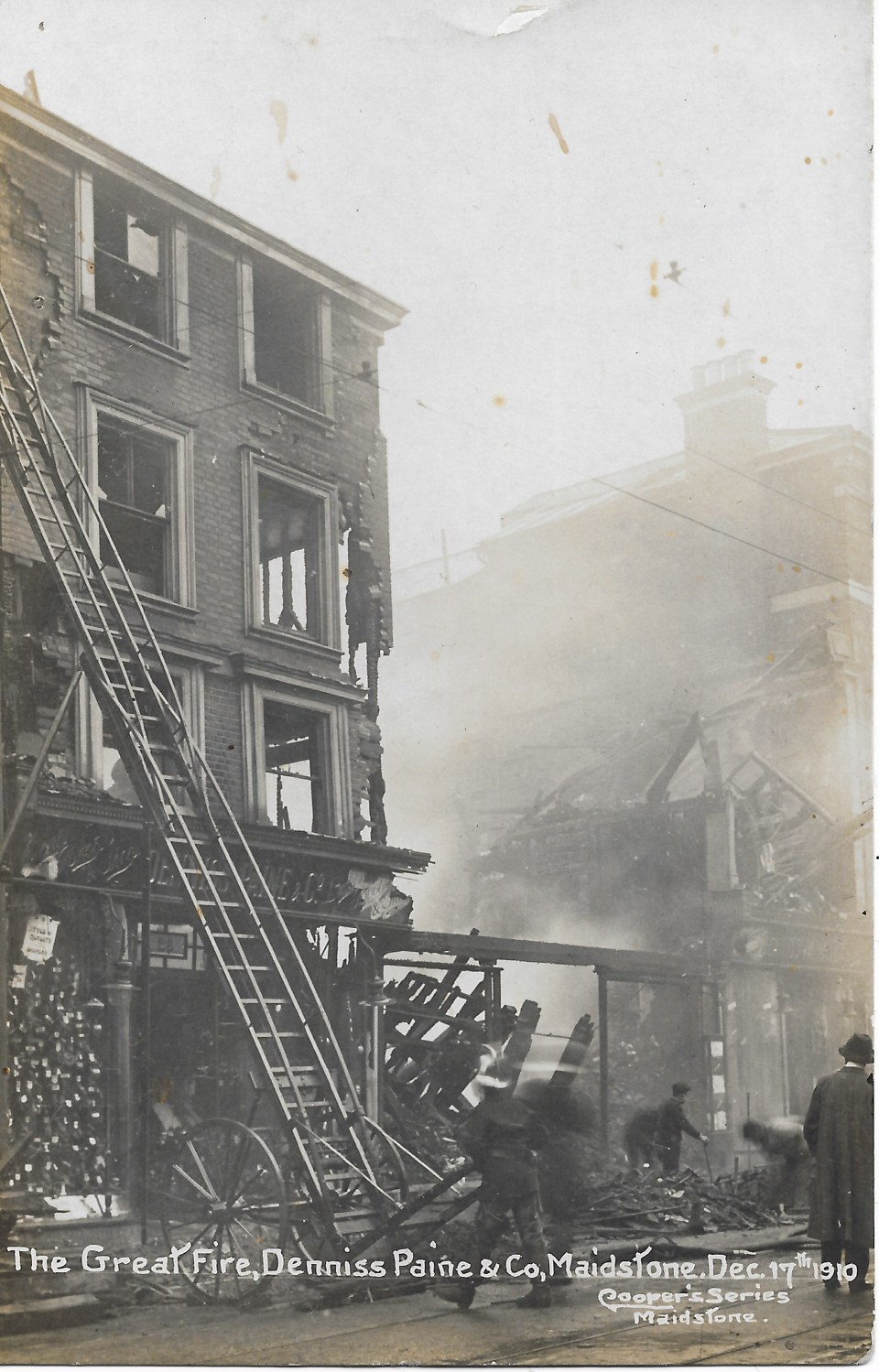
The fire that occurred at the Denniss Paine shop in the High Street was one of the worst fires in Maidstone’s history and resulted in the death of one of it’s youngest employees Oliver Goldsmith Hammond. Oliver who lived with his parents John and Thirza Hammond at 238 Upper Fant Road, had only been employed at the shop for just over a week. Oliver was one of ten children. The shop was one of the oldest established businesses in the town and comprised of several adjoining shops in the High Street, it had several departments; including furnishings, millinery, drapery, footwear and outfitters. The fire started in the ‘Fairyland’ display of the toy section, which was at the rear of the drapery department. Dolls and various figures representing a christmas scene were arranged amongst cotton wool and ‘snowflakes’ with lights suspended above the display. A flame was seen to shoot from the ceiling above the display. A dozen customers in the showroom, were startled by a cry of fire, and after a futile attempt to extinguish the flames, staff and customers made their way to the various exits. The fire spread quickly throughout the shop and four employees became trapped in the building: Mr Baker, Mr Morris, Fred Arnold (described as a lad from Tovil) and Oliver Goldsmith Hammond. Fred escaped by jumping from a window in the Millinery department and was caught in a canvas window blind, held by firemen in the street below. Mr Baker and Mr Morris also managed to escape via a lavatory window over the showroom roof. Thousands of onlookers gathered in the street, and precautions were taken by the police, assisted by the boy scouts, roping off an area from the canon to the Star Hotel. The shop roof collapsed and sparks and embers were carried by the wind over Middle row and Bank Street. Hose pipes were ran from all directions and the Corporation fire engine was employed in pumping water from the river. Eight hydrants were brought into service and a mile of piping was used from the fire station alone. The Chatham fire brigade arrived at 7 pm, but were called to a chimney fire at Waterloo Road.
At the Coroner’s inquest, Oliver’s body was identified by his father John Hammond, who stated his son was just fourteen years of age and was employed by Denniss Paine as a shop boy. Mr Paine, a partner in the business was asked by the Coroner, when he had last seen Oliver, and he stated that it was in the showroom and he had instructed him to sweep up part of the shop. Lieut Wainscott of the fire brigade, stated that Oliver had been found in the shop at no. 24 and the second floor had fallen through onto the first floor. The second floor was only accessible by a broad ladder. Mr Paine was asked by the Coroner, if Oliver had any belongings on the second floor; which would have given him reason to access the floor and if he lived on the shop premises. Mr Paine was further questioned about the lighting in the ‘Fairyland’ display. He stated the wiring was installed by the Borough Electricity works and had been in position from 7th December. Howard Tindall,an electrician from the Maidstone Corporation was called to speak about the electric installations and if any safety advice was given regarding the use of combustible materials in the displays. He had advised that two pails of sand, be kept on hand, in case of fire. Howard Tindall said the lights were eight candle power carbon-filament lamps, attached to insulated wires, suspended from the ceiling. He stated the lamps were not considered dangerous, but could become overheated. He stated the wiring was properly installed but there was the possibility that the lamp globes could explode. An employee Gertrude Brooker, stated she had seen a blue light on the left hand side of the ‘Fairyland’ display at 5.20 pm and had ran down the showroom, to switch off the display lights. She heard customers shouting “Fire” and had informed Mr Paine. Mr Pettitt, a buyer from the Toy department, stated he had tried to extinguish the fire, by patting it out with a stick, he stated he had not used the sand as the fire was too advanced and could not be used to extinguish the flames on the ceiling. Mr Hoadley, an electrical engineer from the Corporation, was questioned as an expert and said that if a lamp burst it was possible, for a piece of the feeding in metal above the filaments to be sufficiently hot to fire any very light substance, such as a muslin or cotton wool upon which it fell, but the filament itself would be dead immediately it came in contact with the air. Fred Arnold stated he had last seen Oliver Goldsmith Hammond, when he was attempting to escape the fire, he was following Mr Baker and Mr Morris to the lavatory window but he and Oliver was cut off by the flames and smoke, leaving only two other means of escape, through the warehouse, the route taken by Fred and via the ladder to the second floor above No. 24. Newton Tyman, a packer said he had seen Oliver, sweeping the shop as he was leaving the shop into the High Street, just before the fire started. He had seen the window open at the top of 24 and Oliver at the window. Several witnesses saw Oliver at the window and the firemen attempted to reach the window, but their ladder was too short to reach. The Coroner questioned why longer ladders were not taken to the fire and Capt Gates of the fire brigade explained that as the call came, the hose cart and short ladder were immediately sent. When he arrived at the scene, he asked Mr Paine if he had a roll call of his employees and Mr Paine had informed him, that everyone was accounted for. The long ladders could not be carried on the hose cart and as the fire was close to the station, one man with the cart, 500ft of hose and the short ladder were sent to the scene. Capt Gates had been informed by Mrs Hammond on Sunday at 1.30 pm, that Oliver had not returned home, the building was then searched and his body was found under fallen timber. The damage to the shop was estimated at £70,000.
At the annual Volunteer Fire Brigade dinner in 1895, Captain Gates, of the Kent Fire Office Brigade had warned that the “Denniss Paine’s premises would burn like a matchbox if alight”. The 1910 fire was not the first fire to occur at the premises, there had been two earlier fires; in September 1897 a small fire occurred but was quickly extinguished and again in August 1908, when a youth almost caused a serious fire, by first trying to extinguish a burning gas jet with an oily apron and then when the apron caught fire, by dropping it in some turpentine spilt on the floor. This ignited the remaining stock of turpentine and the fire brigade had taken an hour to put out the fire, causing considerable damage. Unfortunately, for Oliver Goldsmith Hammond; the warnings seem to have gone unheeded. The shop reopened in a third of the premises, the following tuesday. Advertisements advised, new stock would be arriving daily and damaged goods were greatly reduced.
 Grim crimes and unfortunate events in Historic Maidstone