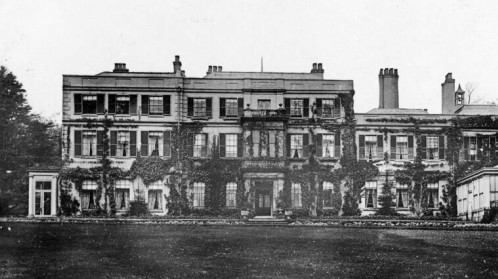
An inquest was held on the evening of 19th June 1890 in the parish room at Teston, by one of the County Coroners Mr T Buss, on the body of the illegitimate child of Ada Goodchild. Ada Goodchild was a 20 year old domestic servant, employed by Captain Vansittart J.P. at Barham Court. Her, child was born on the morning of Monday 16th June, and died having lived only twelve hours from injuries sustained, after birth. After the appointment of Mr James William Penton as foreman of the jury, and the viewing of body of the child, which had been conveyed to the inquiry, the Coroner, then proceeded to take evidence from witnesses. The first witness Sarah Osmond, who was also in service to Captain Vansittart, as a scullery maid, stated she knew Ada Goodchild, and had shared a bedroom with her, since her arrival at Barham Court at the beginning of November. She had never noticed anything wrong with Ada and she had never complained to her, and she was unaware of Ada’s pregnancy. She stated the child was born on Monday morning and believed it to have been born between 10 and 11 o’clock. On the day of the birth, Ada had complained of feeling ill, but had not said what was the matter with her, Sarah had left the bedroom at about half past six and returned at half past eight, when Ada stated she had a headache. When Sarah returned to the bedroom again at 11 o’clock, Ada was sat on the box, and when asked how she was feeling, she replied she was very bad and had given birth, she looked very ill and frightened, but did not say where the child was. Sarah went downstairs to tell the housekeeper Mrs MacDonald and leaving Ada, sat on the box. Mrs MacDonald went to the bedroom alone, and Sarah stated Ada had seemed very weak, when speaking to hear and was crying bitterly, but seemed quite rational. Ada had cried earlier in the morning, but Sarah had thought she was just unwell.
Mrs Catherine MacDonald, the housekeeper to Captain Vansittart, stated that she was in charge of Ada and the other servants and she had been in service to the Captain for three years, she was there when Ada was employed. Ada had never complained of illness, until the day, when the child was born and she had no reason to suspect, she was pregnant. She had worked without complaint, and had completed all her work up until the evening, prior to her confinement. On the morning, Sarah had informed her that Ada was unwell and wanted to stay in her room, until after breakfast, she went to her room and Ada told her, that her head was very bad, but she had not suspected anything was happening. She took her breakfast up to her room at 9 o’clock, and Ada had told her that she was feeling much better. After Sarah had told her of Ada’s confinement at 11 o’clock, she went to the bedroom and Ada was standing at the foot of the bed, when questioned, Ada had refused to speak. Catherine MacDonald, left the room and sent for Jane Bellingham.
Jane Bellingham, a married woman was working at Barham Court on the monday morning, when she was asked by Catherine MacDonald, to go up to see Ada in her bedroom. She told Catherine MacDonald, that a more experienced person, should be sent for. She however went to the bedroom, and on entering, heard a child crying. Ada was alone, and when asked where the child was, Ada had replied that it was in the box, meaning her clothes box. She left the child in the box until Mrs Diprose arrived, but she had not further questioned Ada as she was much depressed and crying. The lid of the box, containing the baby was closed.
Margaret Diprose, a married woman living in Teston, said she was not a certificated midwife, but had attended at many births. She was called to attend Barham Court and went to the bedroom of Ada Goodchild. She was informed of the circumstances and found the child in the box. She attended to the child and mother, she stated the child had been born regularly, but the child’s face was injured, she believed as a result of the box lid closing on it. The child was in a box, and the heavy lid of the box, had pressed against it. The mother Ada was not in a condition to attend to the child, as she had fainted. The child was getting weaker and Dr Fry was sent for by Captain Vansittart. She believed the child was born in the chamber.
Dr John William Fry, stated he was in practice at Wateringbury, and had been called to Barham Court, after having received a letter at his house. The letter from the mother of Mrs Vansittart, stated she was writing in the absence of her daughter, for him to attend at once to one of the maids, who had been confined. He went immediately and saw Ada comfortably in bed, with the child lying by her side. The child seemed fully developed and full grown. He ascertained Mrs Diprose was attending to them and gave some medicine and then left. He received a further letter in the evening from Captain Vansittart, expressing his regret, but that the child was very ill and could he come again to the house. He went immediately, but on entering the bedroom discovered the child was dead. Mrs Diprose showed him the injury to the child’s head and he stated he was unaware of the injury, when he had attended in the morning. He was informed of the day’s preceding events and at the Coroner’s instructions he had performed a post mortem examination. A large wound was found on the skull and scalp, the skull having been drive in. He had questioned Ada on the thursday morning, asking whether she was aware of the pregnancy, which she denied. He asked why she had not requested a doctor, to which she did not reply. He asked her to describe the birth and she stated, that she was in great pain, so she had got out of bed and sat on the chamber, and the child was born with considerable force into it. She then heard someone coming and so had picked up the child and put it, in her clothes box, which was half full with clothes. The lid had fallen down and she fainted.
The Coroner then questioned Dr Fry, asking if the internal organs of the child were healthy and whether the head injury was consistent with the statement, that the box lid had fallen on the child. Dr Fry confirmed that in his opinion, that the child was born healthy and the injuries were sustained after birth, from the box lid. As the box was half filled with clothes, there lid had pushed against the child’s skull and the scalp being very thin, a hemorrhage had occurred, and the resulting blood loss was the cause of death. The Coroner asked whether the child falling into the chamber, could have caused the injury, but Dr Fry believed the injury was sustained from the box lid. He said there were no other signs of violence on the child and he had seen nothing in the bedroom, which might have caused the injuries. He had attended to Ada, earlier in the year, when she was unwell, but was unaware of the pregnancy, at the time. Concluding Dr Fry, stated that he did not think Ada had any criminal motives and thought if she had intended to make away with the child, she would have not done so, in such a clumsy fashion.
Summing up, the Coroner said it was for the jury to return a verdict in accordance with the evidence. He thought the jury would agree with him, that Ada Goodchild was delivered of the child, surprisingly, and hearing someone coming, she on impulse, had placed the baby in her clothes box. He also thought they would agree that there was no intention of concealment and if she had intended that, he thought she would have put the child away in a different way. He did not consider a charge of murder was appropriate as to send a person for trial on that charge, there must be evidence of premeditated or secret plans. There might be some doubt in the jury’s minds as to a charge of manslaughter, but he thought that under the circumstances and bearing in mind, the state of the poor girl at the time, she had no intention of killing or causing the infant’s death. He therefore suggested a verdict of accidental death and although the final verdict was one for the jury, if there was a trial for manslaughter, he did not consider she would be convicted. The Foreman asked if Ada would be prosecuted for concealment, to which the Coroner replied, that it was a matter for the police to make further inquiries, and if evidence was found, it would be for the police to pursue. The jury recorded a verdict of accidental death and the inquiry terminated.
©grimcrimesandunfortunateevents
 Grim crimes and unfortunate events in Historic Maidstone