The area known as St Faiths, in Maidstone was an area, where some of the poorest residents of the county town resided, some of my own family lived in houses on St Faith’s Green during the 1850’s. The following is extracted from the Maidstone and Kentish Journal of 25 January 1894, and gives an insight into a time, long forgotten.
Nooks and Corners of Old Maidstone – St Faiths Street
I must confess that the street known by the above named ancient title, is not one of the most attractive in the good old county town, and were it not for the time honoured building of Chillington Manor House, with its glorious library, its invaluable museum treasures and contiguous public gardens would be decidedly the shabbiest of the shabby. Many of the old houses have been demolished and in their stead stand miserable-looking coal and other stores and a comminglement of wretchedly built, and ill favoured modern cottages. Many of the ancient glories of the street, have escaped, however the ruthless hand of the vandalistic iconoclast, and peering here and there from the midst of ungainly neighbours, can be seen on the right going towards the flowing Medway gabled structures, which be speak the grandeur of better days. These houses stand up from the road, upon an elevation, access to which is gained by steps of somewhat dangerous precipitousness. The street ends with the open rive, which here laves the roadway with soft and musical murmuring sound. Facing the musem gardens are six solidly built, and picturesque almshouses, erected by the munificence of Sir John Banks, in the year 1769, in which six poor aged men and women, find a comfortable shelter, and a solatium of £10 yearly.
In the days which have long since departed the locality of St. Faith’s, from what can be gleaned from the local records, was, although in the town, a kind of village in itself. It possessed a historic green, upon which sports and pastimes were indulged in and where the youth met to find judicious exhiliration and recreation. it had, too, a venerated fane in its famed chapel, which was erected in the 13th century.
From what can be gained of its history it appears that early in the 16th century it was annexed to the College of All Saints, and when that organisation was dissolved it was purchased by the Corporation, the property being described in the first charter as one chapel and one church yard, or piece of land commonly called St Faith’s churchyard.
Mr Russell, in his excellently compiled History of Maidstone, states the property was afterwards sold by the town to Peter Maplesden, of Dijons, with a reserve to the parishioners of liberty to hold Divine service in a part of the chapel, and to use the churchyard for burials. It passed in 1561 into the hands of Nicholas Barham, of Chillington House, and in 1572 the Corporation granted the use of the chapel and yard to the Dutch refugees, who had settled in the town. Barham’s son Arthur sold the property in 1609 to Henry Hall, and the latter devised it to his grandson George, who in 1624 disputed the rights of the Corporation. In the following year they made an order that householders and their families who for their poverty be not assessed to the poor” were to be buried in St. Faith’s yard. The order, however was not carried out, and Hall would appear to have relinquished his contention as far at least as regards the Dutch people, who continued to hold their services in the chapel until 1634, when it was closed by the Archbishop Laud. It was opened again in 1646, and for the next 90 years, with little interval, was used by different bodies of Non conformists. For some years it was used as a ladies’ boarding school, and subsequently was utilised as a storehouse for the West Kent Militia. It was pulled down in 1858. All that remains of its destruction are two pillars, with the capitols and bases, These are now to be seen in the garden at the back of the Museum. Relics of the old chapel are preserved in prints of the period.
Anent the Dutch settlers, who figure so prominently in the history of the chapel, it may be mentioned that the Walloons or French speaking Flemings, migrated to England to escape religious persecution, and a body of these made a settlement in Maidstone in the reign of Good Queen Bess in the year 1573, The Corporation granted them the use of the old Chapel of St. Faith and the burial ground, and history shows that they were the first Nonconformists who, as a body worshipped in the county town. Archbishop Laud endeavoured to impose certain restrictons upon them. These were resisted, but it was not until the Commonwealth that their old liberties were restored to them. The present handsome church, with its noble and commanding tower, was erected in 1871 on the site of the old chapel, and is by far one of the finest specimens of the ecclesiastical district churches of the town. It was consecrated in September, 1872, and is an excellent specimen of the early English decorated style, and is dedicated to St. Faith, Virgin Martyr. Its sittings number over 600, and they are all free and unappropriated.
Before the building of the church, and the opening of the garden, the locale had sunk to a very low standard, being a nest of rookeries, foremost in which figured an alley, known as that of Bone. This was the favourite abode of chimney sweeps, men of uncertain calling and peripatetic vendors of edible comestibles. The London, Chatham and Dover Railway have opened up the Station-road, and now the green and all pertaining to it have passed into the limbo of the forgotten and unregrettable.
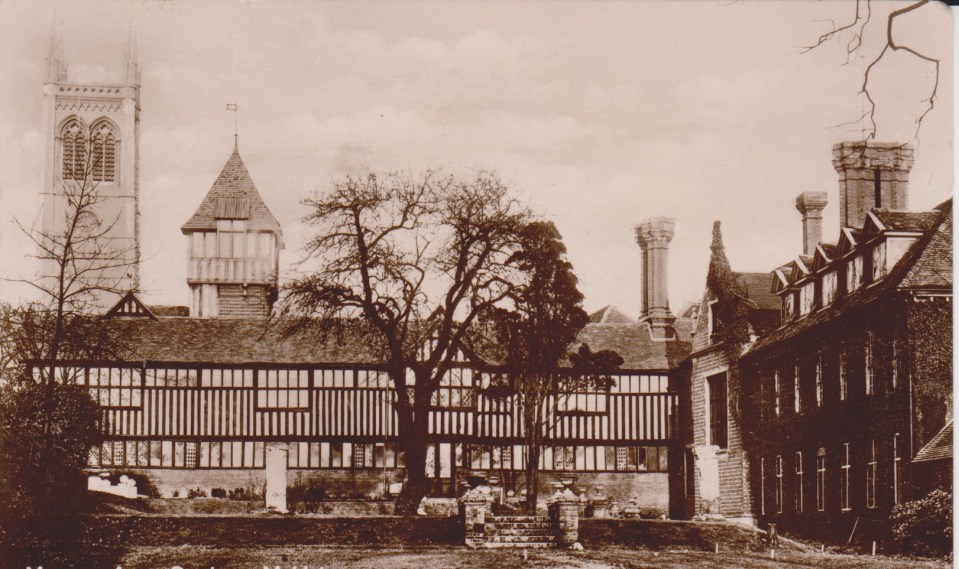
The main object of antiquarian interest in this quaintly complex locality is the Chillington Manor House, which is in a rare condition of intact preservedness. The entrance porch, the common hall and the cloister connecting the chapel with the building, are splendid specimens of the Mansoria l Architecture of the Elizabethan period, The structure dates from 1560, but there is reason to believe that a prior building existed on the site during the reigns of Henry the Seventh and Eighth. During the reign of Elisabeth, the Manor of Chillington and the mansion were sold by Robert and Geo. Maplesden for £500 to Nicholas Barham. Afterwards it passed to the Hall family, and by a succession of changes in 1801, it become the property of Mr William Charles, a medical man, at whose death in 1832 it descended to his sons William and Thomas. The last named bequeathed his valuable collection of antiquities to the town, thus forming the basis of the present magnificent museum. In course of time the Corporation purchased the Museum and adjoining garden.
In the year 1858 Mr Edward Pretty, an old scientific friend of Thomas Charles, was appointed curator of the Museum, and right lovingly did he carry out his duties. He died in 1865, and bequeathed his fine library, antiquities and pencil and water colour sketches, the result of his own labours, to the Museum. He was succeeded by another enthusiastic curator, namely, Mr Wm Lightfoot, during whose term of office the east and west wings were added to the building through the public spirited generosity of the late Alexander Randall, Samuel and Richard Mercer, and Julius Brenchley. The most recent addition to the building is the Bentliff wing, erected in 1890, as in memoriam to the late Mr George Bentlif, and which serves the purposes of an art gallery and reference library.
Facing the old green and chapel are now the schools of St. Faith, and the commanding premises of the Maidstone and Kentish Journal and the Kent County Standard. The features of the past St. Faith, now for the part live only in historic records, but their memories will long be recalled, and as affording interesting musings for the antiquarians, the nook and corner will often be reverently visited.
 Grim crimes and unfortunate events in Historic Maidstone